
Free Printable Math Worksheets for Kids
Five complete sets, one clear path — built within 10 first, because that is where real number sense is built, then carried into 20 once the bonds are automatic. (One optional two-page challenge at the end of Step 3 reaches toward 20 early, for kids who ask for more.) Your child starts by splitting numbers into parts they can count, learns those bonds until they are automatic, stretches them into two-step problems, works puzzles where every answer has to work two ways at once — and finishes by regrouping into 20 with four taught strategies. 71 pages, 737 puzzles and problems, each set free with its answer key where one is needed.
100% Screen-Free
One Path — Five Steps, In Order
This is not a pile of unrelated pages. Each set assumes the step before it and prepares the step after, so “what do we print next?” always has an answer. Tap a cover to jump to its set.
The Five Math Sets
Listed in path order — the order most children should work through them. Filter by grade if you already know where your child is.
 STEP 1 · START HERE
Cover + page inside
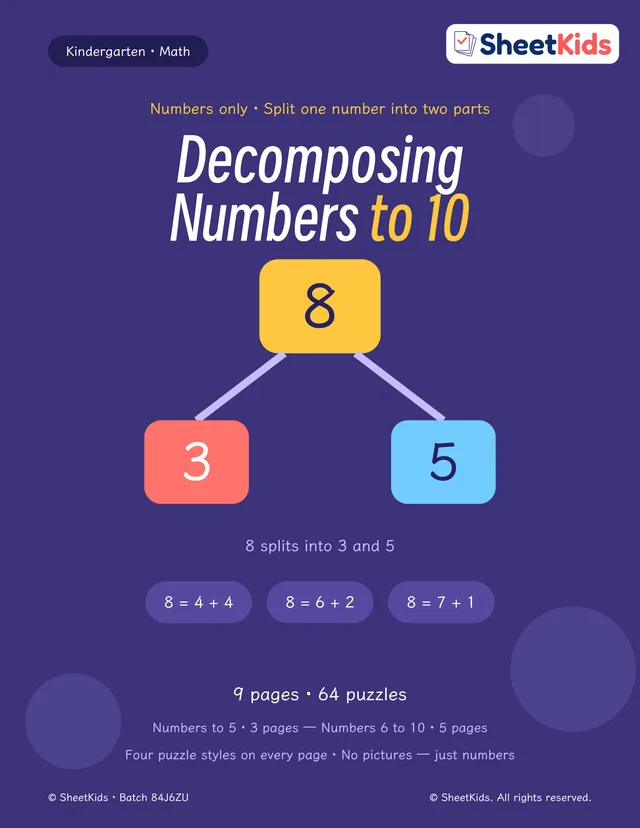
Decomposing Numbers to 10
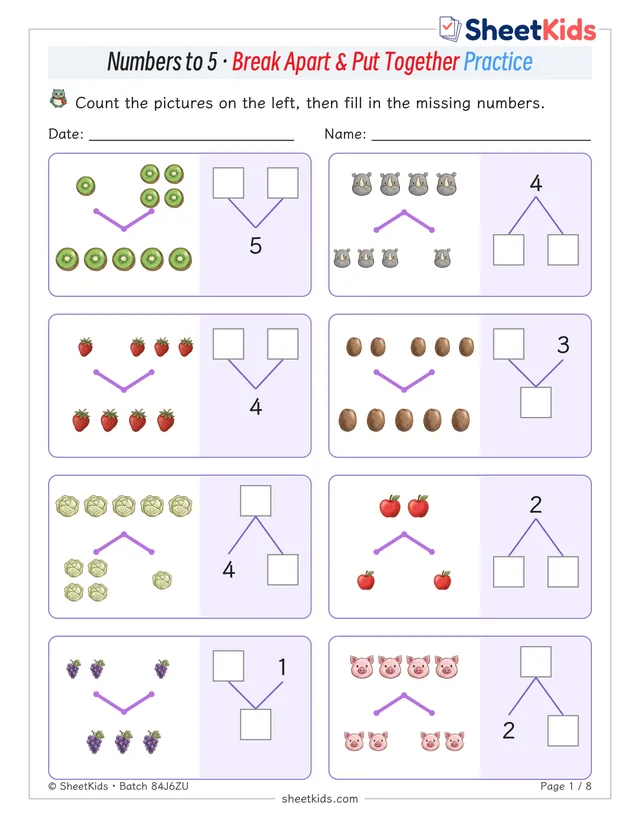
Where the whole path begins: every number from 2 to 10, taken apart and put back together until “7 is 3 and 4” feels obvious. The first three pages stay within 5, the last five move up to 6–10, and each page mixes four puzzle styles — split a pictured group, complete a bond diagram, build a whole from two parts — so a child meets the same idea from several angles instead of memorizing one worksheet format. Because every bond sits next to pictures that can be counted, answers check themselves right on the page.
 STEP 2
Cover + page inside
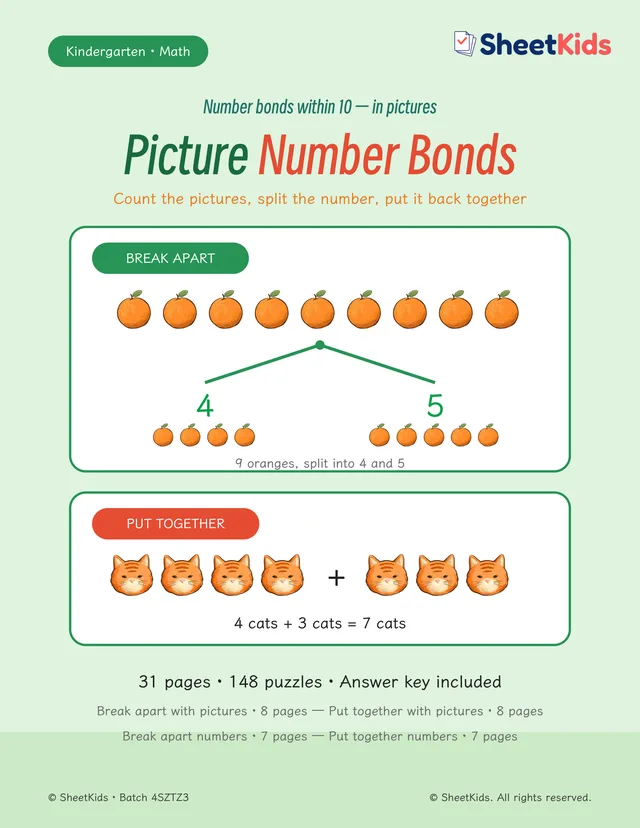
Picture Number Bonds — Break Apart & Put Together to 10
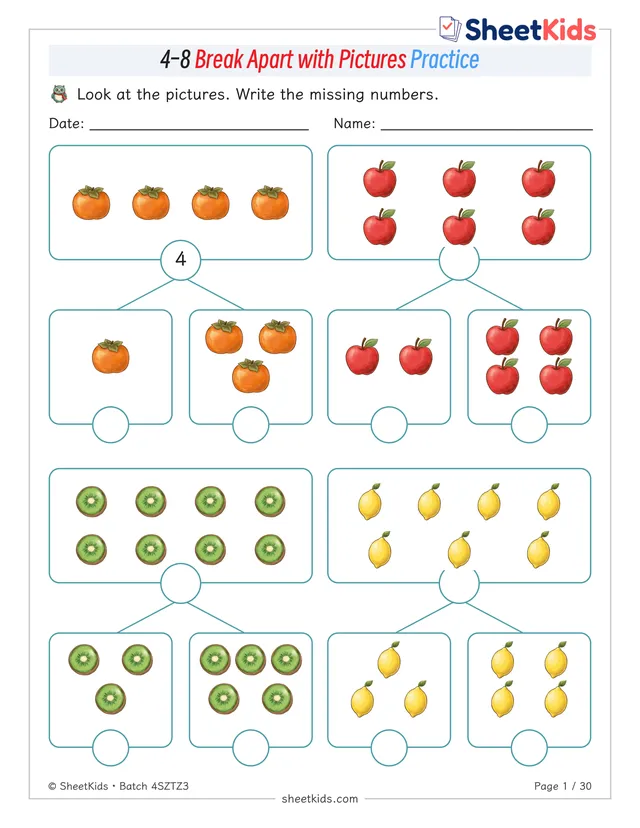
The deep practice set — the one families spend the most weeks in. It takes the bond idea from Step 1 and runs it in both directions, at full length: 16 pages where strawberries, cats and koalas can still be counted, then 14 pages where the pictures step aside and the same bonds have to be held in the head. By the last page, “what goes with 7 to make 10?” is answered from memory, not counting — which is exactly the fluency the next two steps stand on.
 STEP 3
Cover + page inside
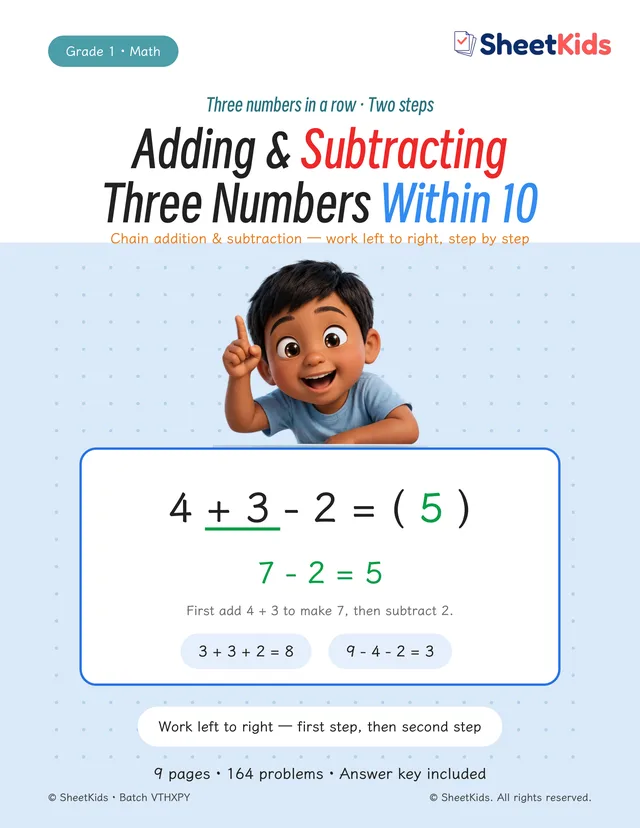
Adding & Subtracting Three Numbers Within 10
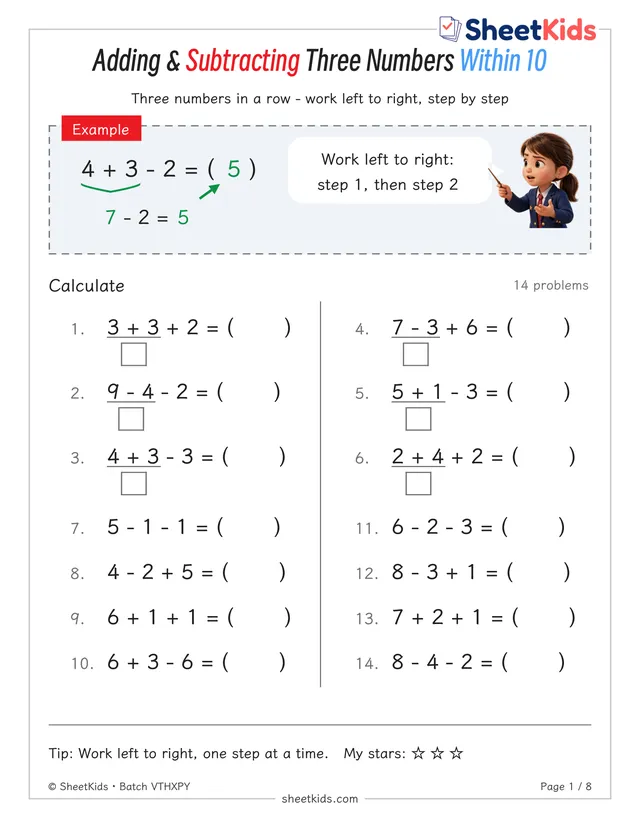
Bonds become arithmetic. Each problem is a short chain — 4 + 3 − 2 — solved left to right in two visible steps, and the set rotates three kinds of thinking: plain chains, chains with the signs missing, and chains with a number missing. Every new kind opens with worked examples before its practice page, and the final two pages stretch into an optional within-20 challenge for kids who finish hungry. In the main pages, no single step exceeds a bond to 10 — the difficulty is holding two steps, not bigger numbers.
 STEP 4 · CHALLENGE
Cover + puzzle inside
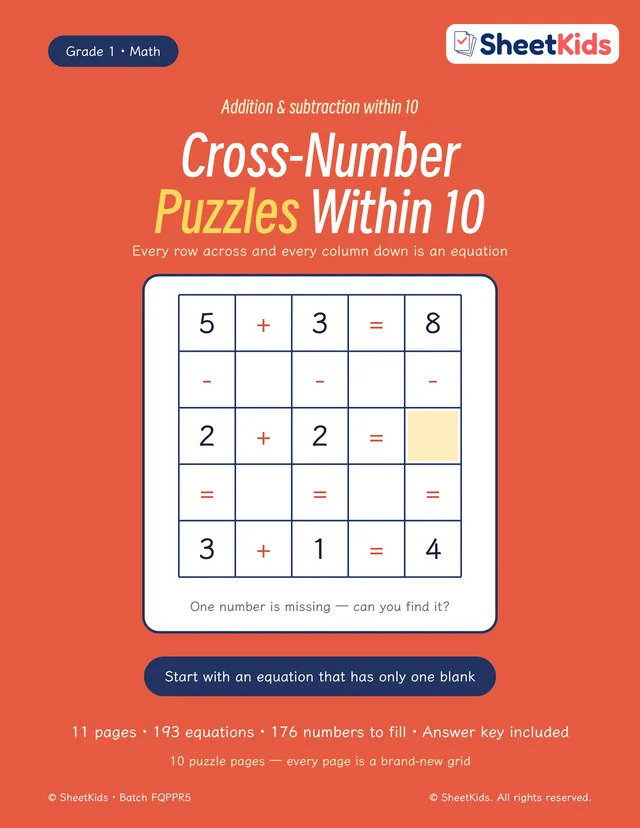
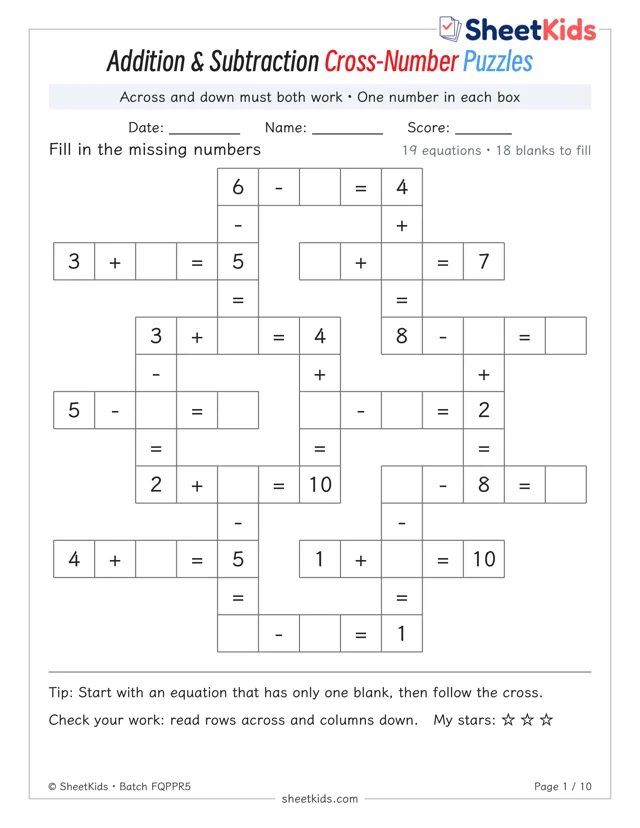
Cross-Number Puzzles Within 10
The reward at the end of the path — and the set kids ask for by name. Each page is a crossword-style grid where every row across and every column down is an equation, and the crossing cells are shared, so one wrong number quietly breaks two equations and a right one locks both in place. It is the only set here that checks itself as your child works: the strategy printed on every page — start with the equation that has only one blank, then follow the cross — turns 176 blanks into a solvable hunt instead of a wall of sums.
 STEP 5 · INTO 20
Cover + page inside
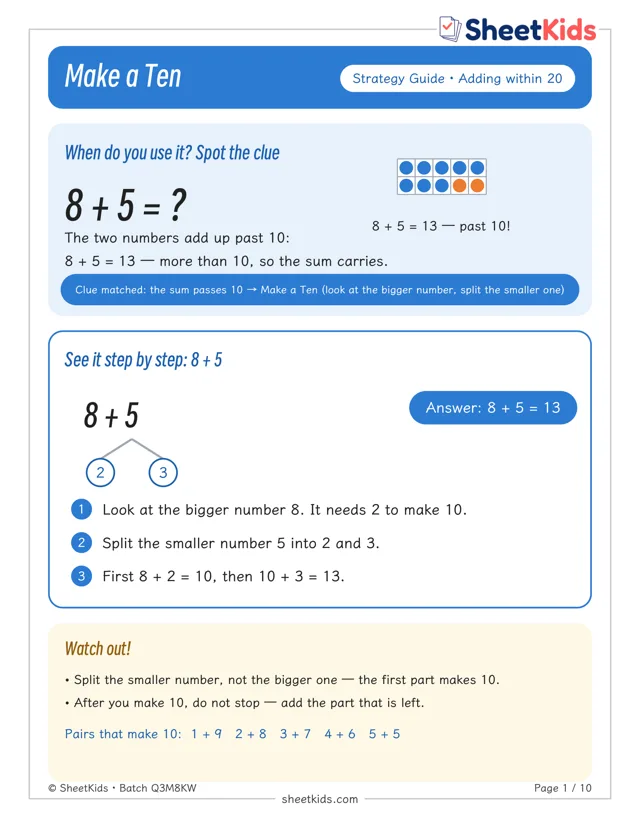
Adding & Subtracting Within 20 with Regrouping
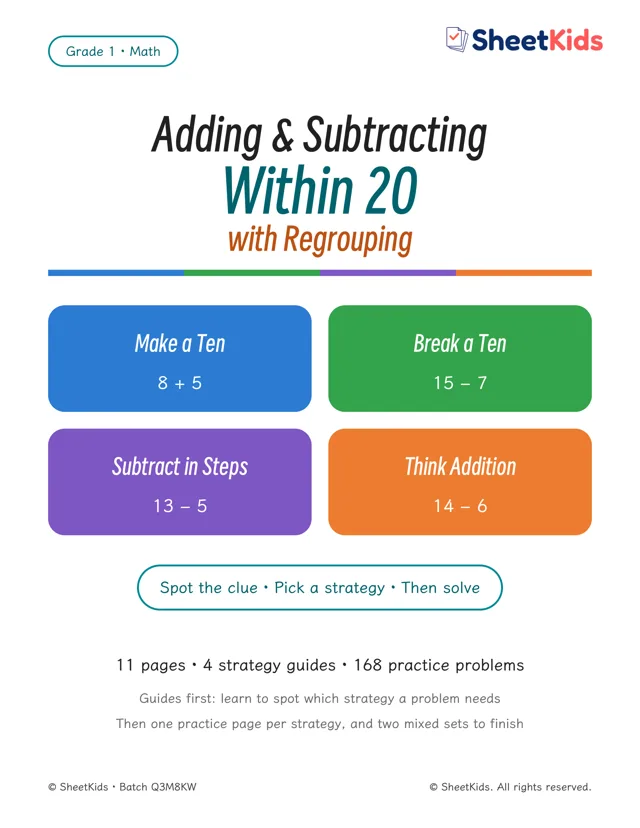
The step the whole path was pointing at: the same bonds to 10, carried into 20. It opens with four strategy guides — Make a Ten, Break a Ten, Subtract in Steps, Think Addition — worked through 37 example entries before a single practice problem appears. Then come four practice pages, one per strategy, and two mixed pages where picking the right strategy is part of the problem. Nothing here is a new subject: 9 + 5 is the bond 5 = 1 + 4 wearing a bigger number, and the guides show that move until it feels obvious.
The Math Path, Step by Step
Why these five sets, why this order — and what each step is really teaching underneath the worksheets.
Decomposing builds the idea
Before a child can add, they have to believe something that adults take for granted: a number is made of parts. Seven is not just the word after six — it is 3 and 4, 5 and 2, 6 and 1, all at the same time. Decomposing Numbers to 10 teaches exactly that, and nothing else. Pictures sit beside every bond so the parts can be counted and touched, numbers to 5 come before 6 to 10, and the four puzzle styles keep the thinking fresh while the idea sinks in.
Most children need days here, not weeks — and that is fine. This step is short on purpose: it is the doorway, not the house.
Picture bonds make it fluent
Understanding a bond once is not the same as knowing it instantly. Picture Number Bonds is the fluency step: 148 puzzles that repeat the bonds to 10 until recall replaces counting. The staging matters — the first 64 puzzles can still be counted on the page, the last 84 cannot — so support is withdrawn gradually instead of all at once.
It also practices both directions from the start. Breaking apart is subtraction in disguise; putting together is addition. A child fluent in both directions meets the + and − symbols later as names for moves they already own.
Chains make it arithmetic
With bonds automatic, working memory is free for the next demand: holding an intermediate answer. In Adding & Subtracting Three Numbers, 4 + 3 − 2 is really two bonds in a row — make 7, hold it, take away 2 — and the page layout shows both steps so the method is visible, not guessed. The missing-sign and missing-number pages then reverse the thinking: given the answer, what must the middle have been?
That reversal is quiet preparation for early algebra, built entirely from numbers a 1st grader already trusts.
Cross puzzles make it stick
The final step changes the game, not the numbers. In Cross-Number Puzzles, every blank belongs to two equations at once, so children must plan (which equation can I solve first?), check (does it still work downwards?), and backtrack when a crossing disagrees. Those are problem-solving habits, practiced on arithmetic that is deliberately easy.
Because the grids self-check, this is also the most independent set on the page — the one to hand a child who wants to “do math alone” while you make dinner.
Within 20 makes it grow
The first four steps deliberately stay within 10; this one spends that fluency. Adding & Subtracting Within 20 with Regrouping teaches four named strategies — Make a Ten, Break a Ten, Subtract in Steps, Think Addition — and it teaches them before it tests them: four guide pages work 37 examples in full, so a child meets each method as a move on numbers they already know, not as a rule to memorize.
Then the practice mirrors the teaching: one page per strategy, then two mixed pages where the real skill is choosing. A child who finishes Step 5 has not just met regrouping — they have four ways to do it, and the beginnings of judgment about which one fits.
Why the path stays within 10 — first. It is tempting to rush on to bigger numbers, but within 10 is where the foundations either set or crack. A child who knows the bonds to 10 by heart can build almost everything later from them: 7 + 8 becomes 7 + 3 + 5, subtraction within 20 becomes a bond read backwards, and “make a ten” strategies stop being tricks and start being obvious. The first four sets spend 58 of their 60 pages inside that small territory on purpose — the only exception is the optional two-page within-20 challenge that closes Step 3 — depth first, then range. When a child finishes Step 4 comfortably, Step 5 takes those same bonds into 20 with regrouping — and it feels easy precisely because the within-10 work came first.
A rhythm that works. One page a day, about 5–10 minutes, is plenty — the sets are sequenced so that a page a day moves steadily through the path without review spirals or catch-up days. Let your child check finished pages against the answer key themselves where a key is provided; finding and fixing their own miss is part of the learning, and the keys mirror the practice pages one to one to make that possible. If a page goes badly, do not repeat the same page the next day — drop back half a step (from chains to bonds, from number-only bonds to picture bonds) for a day or two, then climb again. The path is short enough that a small step back costs almost nothing, and it works far better than pushing forward on shaky bonds.
Which Set Fits Your Child Today?
Skip the guesswork — match the description, start there, and let the path do the rest.
“Counts to 10, but 7 is just… 7”
Your child can recite numbers and count objects, but if you ask what two numbers make 7, they count from one every time. The part–whole idea is not there yet — and everything else waits on it.
Start with Step 1 · Decomposing →“Knows some bonds, still counts on fingers”
The idea is there; the speed is not. Your child gets bonds right but slowly, and addition means counting up from the first number. This is a fluency gap, and fluency is a volume game — 148 staged puzzles of it.
Go to Step 2 · Picture Number Bonds →“Bonds to 10 are instant — now what?”
Ask for the parts of 9 and the answer comes without a pause. Single-step work is done; the next growth is two-step thinking and self-checking. Start with chains, and keep the cross puzzles as the prize in view.
Jump to Step 3 · Three Numbers →Look Inside: Five Sets, Five Formats
Variety is the point — a bond diagram, a counting page, a chain page, a puzzle grid and a strategy page ask for five different kinds of thinking. Tap any page to see it big.
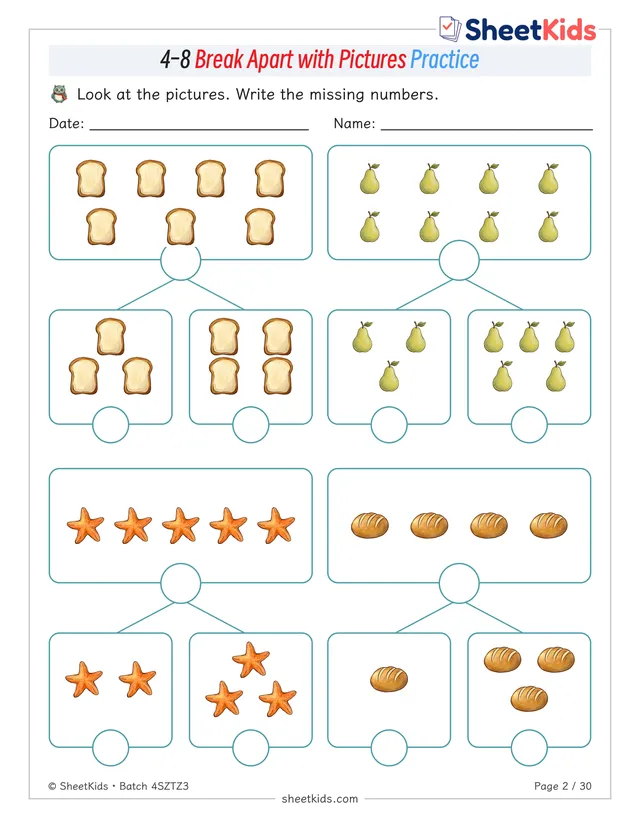
Drawn to be counted. In the two picture-based steps, the artwork is the math: fruits and animals are hand-drawn in one soft style and spaced so small fingers can touch-count them one by one. If a child can’t count it, it doesn’t belong on the page.
How It Works
Start at your step
Use the guide above — most kindergarteners start at Step 1, most 1st graders at Step 2 or 3.
Print one page a day
US Letter, 100% scale. Color for picture pages, grayscale is fine for number-only pages and grids.
Check & climb
Check together with the answer key, then move one page — or one step — forward. Small, daily, done.
Questions Parents Ask About Math
Are these math worksheets really free?
What ages and grades are the math worksheets for?
Where should my child start?
Are answer keys included?
How do I print the worksheets?
How is this different from random math worksheets online?
Beyond Math
Math is one of 5 SheetKids categories. The same complete-set, no-sign-up rules apply everywhere.
Alphabet & Phonics
Letters, sounds and first words — 1 set, 27 pages.
Explore Alphabet & Phonics →Logic & Focus
Focus, logic and visual scanning training — 2 sets, 33 pages.
Explore Logic & Focus →Handwriting
Tracing, stroke order and handwriting practice — 2 sets, 24 pages.
Explore Handwriting →Flashcards
Guessing flashcards and picture cards — 3 sets, 15 pages.
Explore Flashcards →Start at Step 1 — or wherever your child is.
Five free sets, 71 pages, one clear path — through 10, then into 20. Print the first page of your step today and be done in ten minutes.
See the 5 Math Sets