
Free Printable 1st Grade Worksheets for Ages 6–7
First grade is where arithmetic grows up. The year's big idea is the jump from numbers within 10 to numbers within 20 — and the children who make it easily are not the fastest counters, but the ones with strategies: make a ten, break a ten, subtract in steps, think addition. This page collects 9 complete sets, 123 pages, built around that jump: a strategy-first regrouping set at the centre, equation writing and clock reading beside it, and the within-10 fluency and logic work that keeps the foundations fast. All free to download and print.
100% Screen-Free
What first-grade practice actually builds
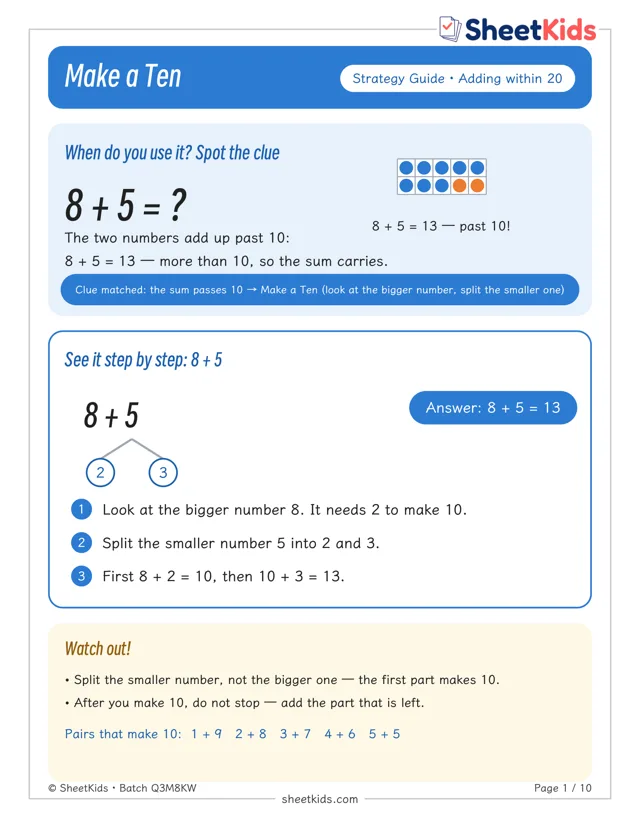
Regrouping is a strategy problem, not a effort problem. A child facing 8 + 5 who counts on from 8 will survive first grade but struggle in second; a child who splits the 5 into 2 and 3, makes 10, and adds the rest owns a method that scales to hundreds. That is why the Within 20 set on this page teaches four named strategies in worked guide pages before it asks for speed — 37 guided entries first, then 168 problems that practise each strategy separately before mixing them.
Fluency within 10 still matters, precisely because working memory is limited. Every second a first grader spends reconstructing 6 + 4 is a second not spent on the regrouping step that follows it. The bond and puzzle sets listed lower on this page are kindergarten graduates, kept here deliberately as warm-ups: instant bonds to 10 are the raw material that Make a Ten is made of.
Two new kinds of literacy arrive this year. Writing equations from pictures turns 'I can see how many' into the written notation every later word problem depends on, and telling time moves from a daily routine to a readable instrument — hours and half hours first, then any time at all, read by counting the minute hand in fives. Logic stretches too: the sudoku ladder now reaches 9×9, and the Schulte grids reach their full 6×6 size.
The 1st Grade Sets
Every set recommended for 1st grade — complete, free, and ready to print, listed in a sensible starting order.
 Cover + page inside
Adding & Subtracting Within 20 with Regrouping
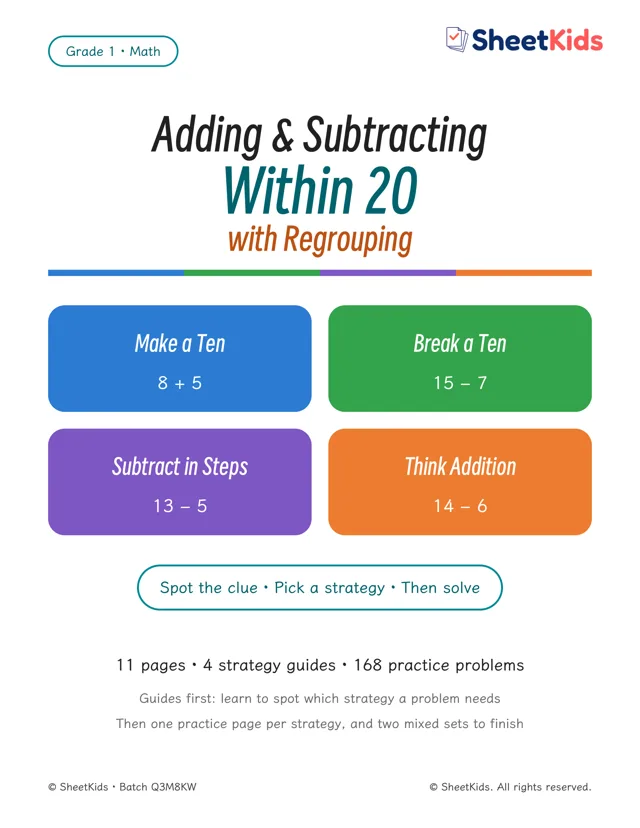
The first-grade centrepiece: four named strategies — Make a Ten, Break a Ten, Subtract in Steps, Think Addition — taught in 37 worked guide entries, then 168 problems that practise each strategy before mixing them.
 Cover + page inside
Write the Equation — Picture Addition & Subtraction
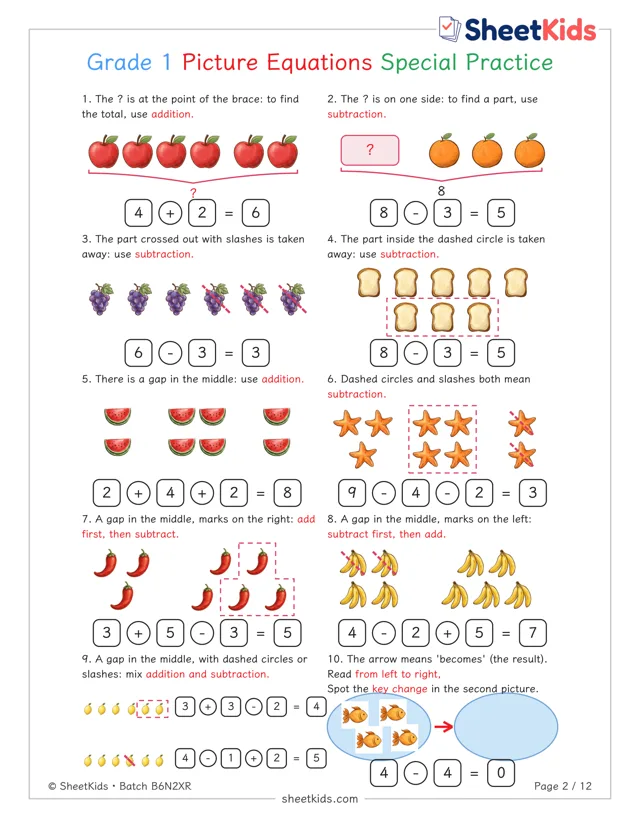
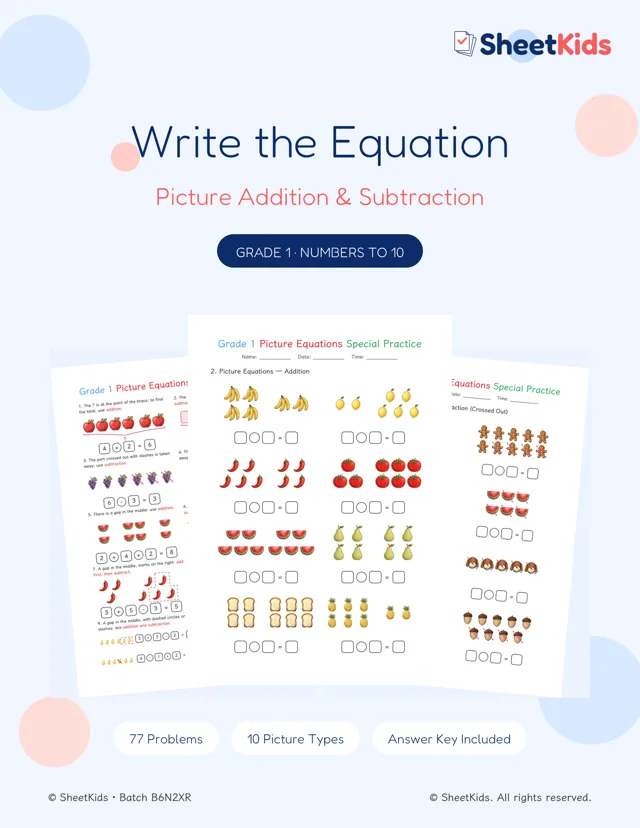
Seventy-seven picture problems that end in a written equation. In first grade this is where 'I can see it' becomes 'I can write it' — the habit every word problem later depends on.
 Cover + page inside
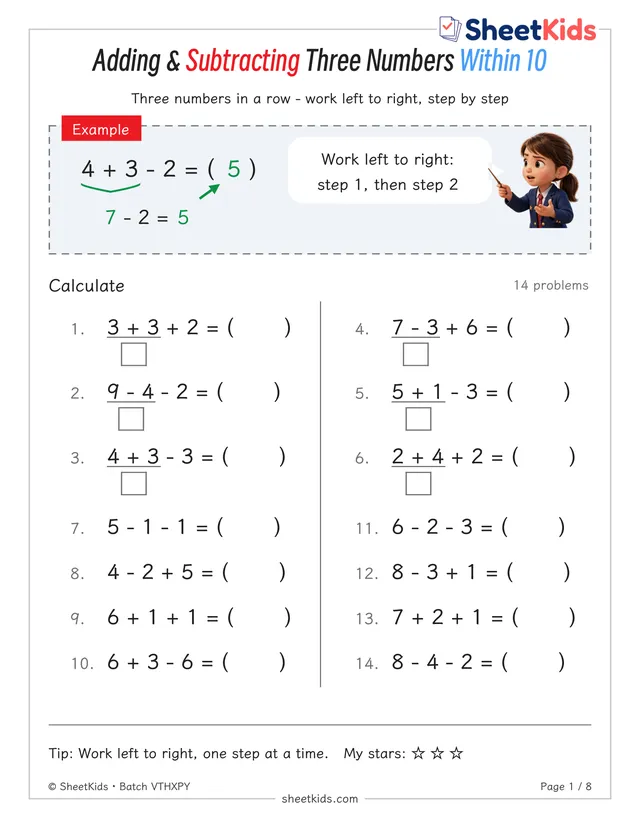
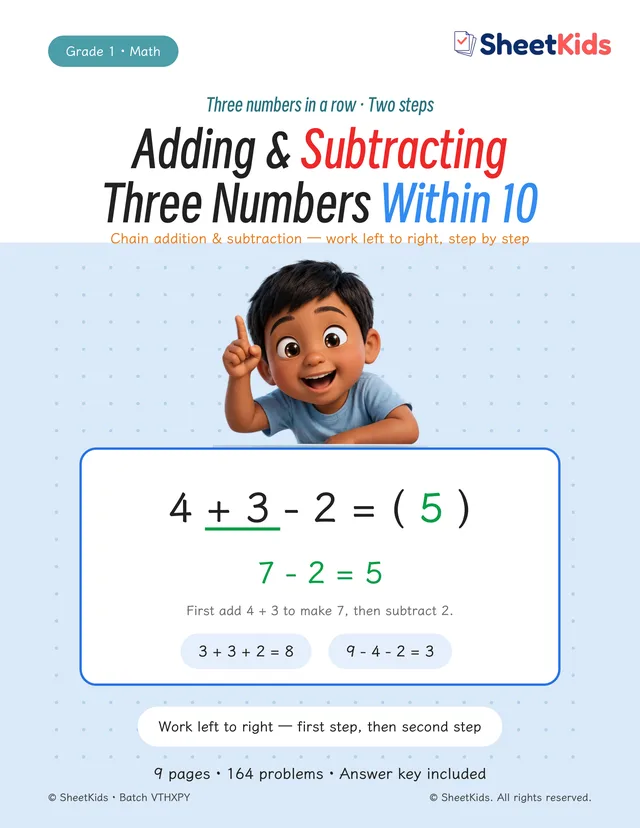
Telling Time — Hours, Half Hours & Minutes
Clocks taught in order: meet the hands, explore the dial, read o'clock and half past, then read any time by counting the minute hand in fives. It finishes with pages where kids draw the hands themselves.
 Cover + page inside
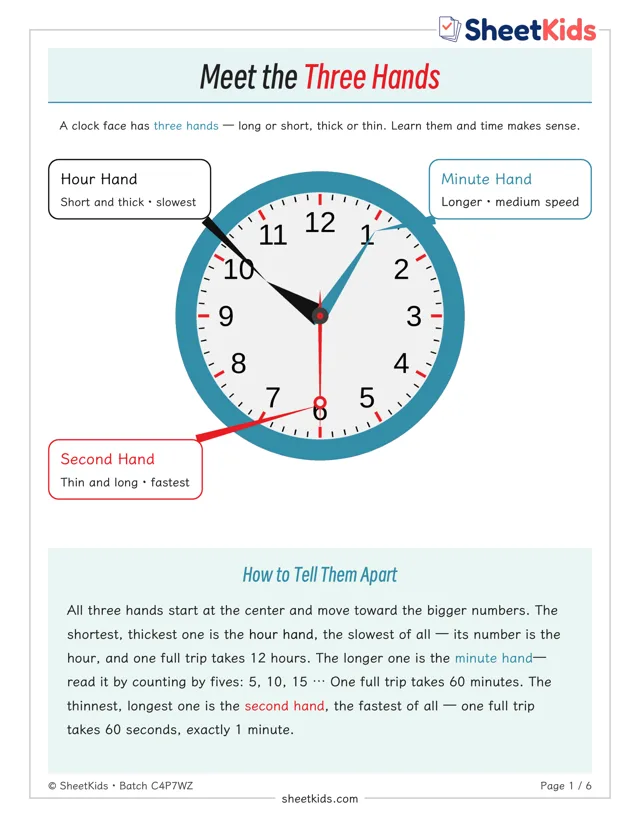
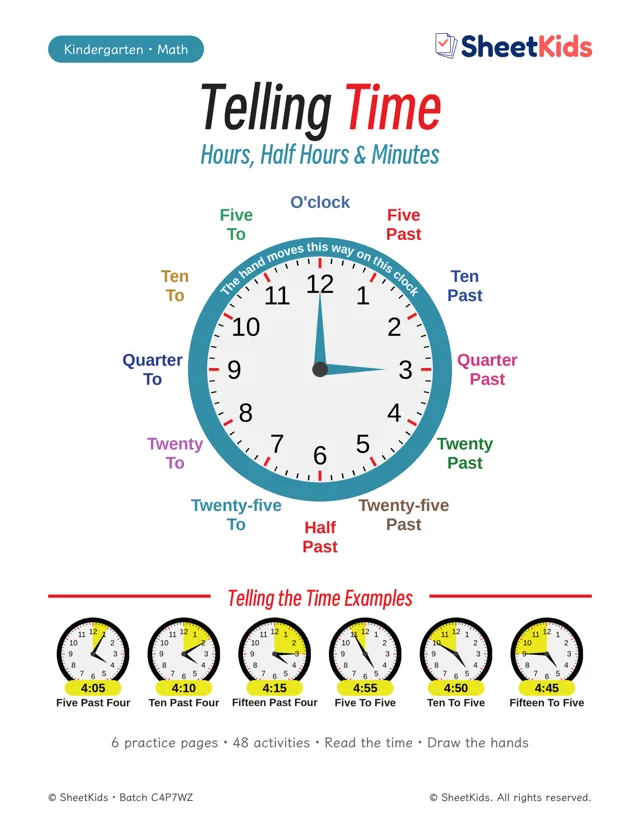
Adding & Subtracting Three Numbers Within 10
Two-step chains within 10 keep first-grade fluency honest: if 4 + 3 − 2 is automatic, the new within-20 work has one less thing to carry.
 Cover + page inside
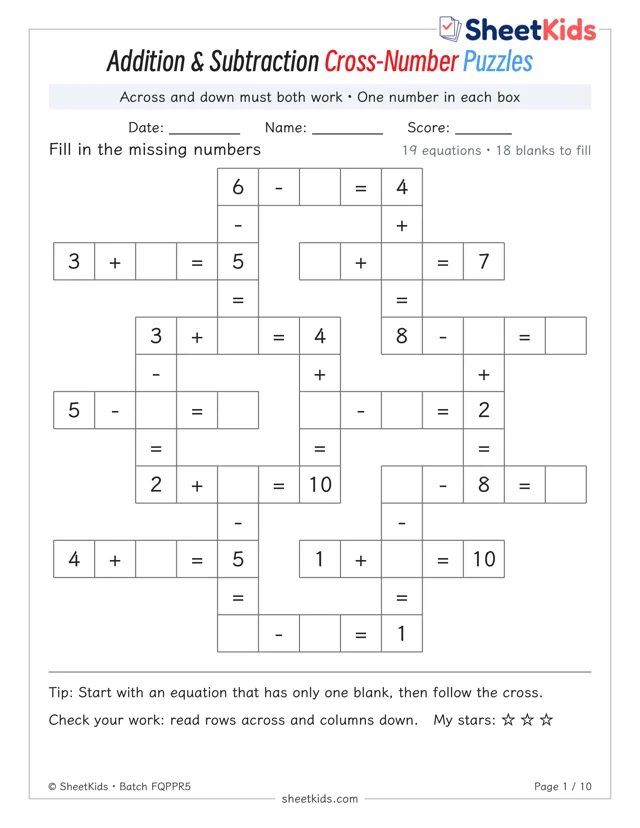
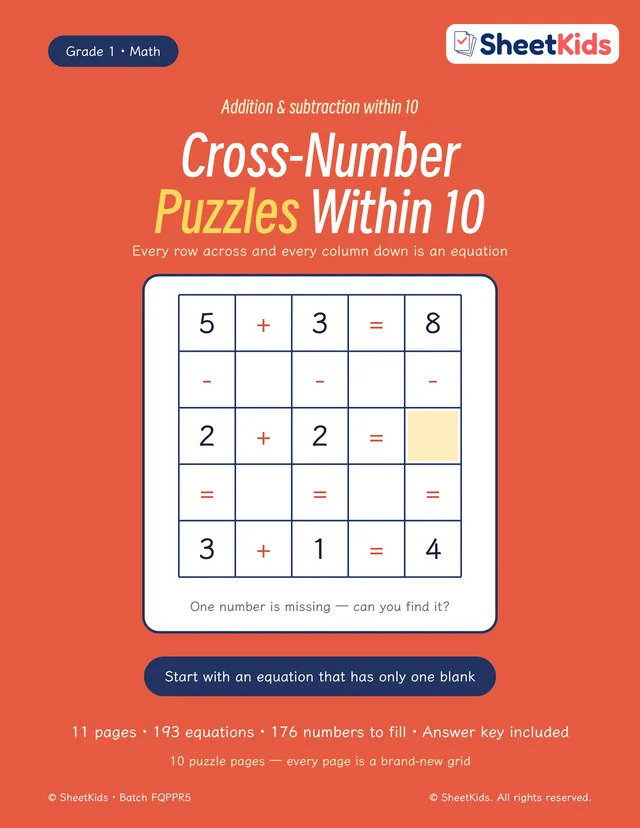
Cross-Number Addition & Subtraction Puzzles Within 10
Grid puzzles where rows and columns are equations within 10 and every crossing cell must satisfy both. First graders use them as fluency training with a puzzle payoff.
 Cover + page inside
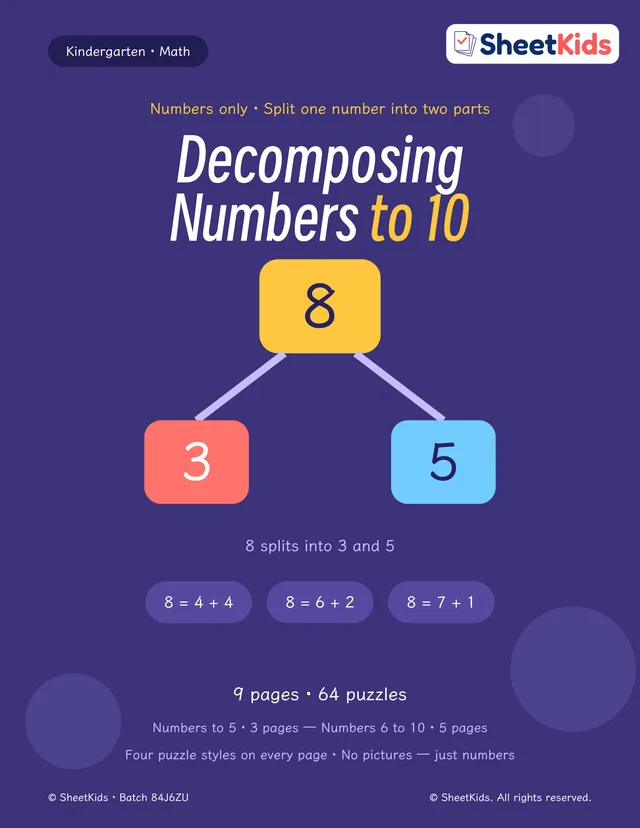
Decomposing Numbers to 10
Still worth revisiting in first grade: instant bonds to 10 are the raw material of Make a Ten. Use this set as a warm-up before the within-20 set.
 Cover + page inside
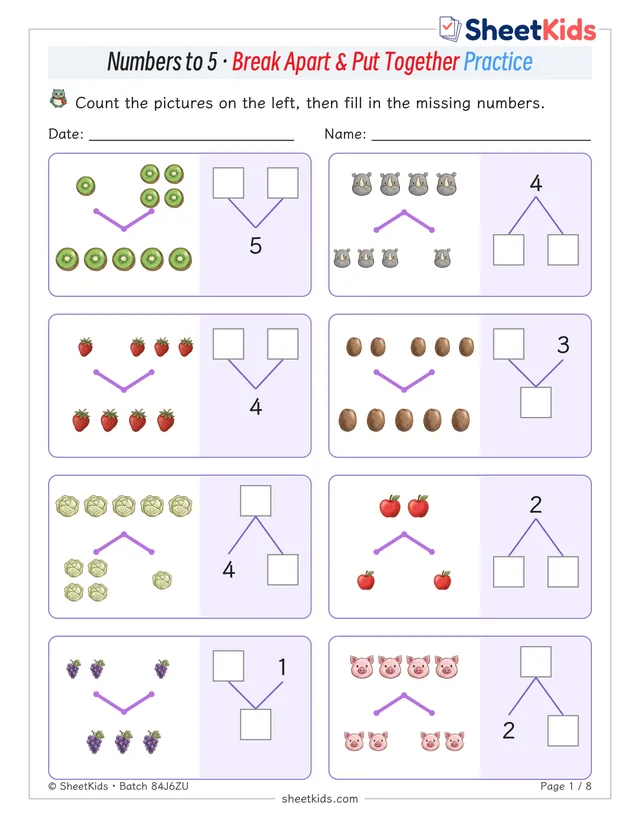
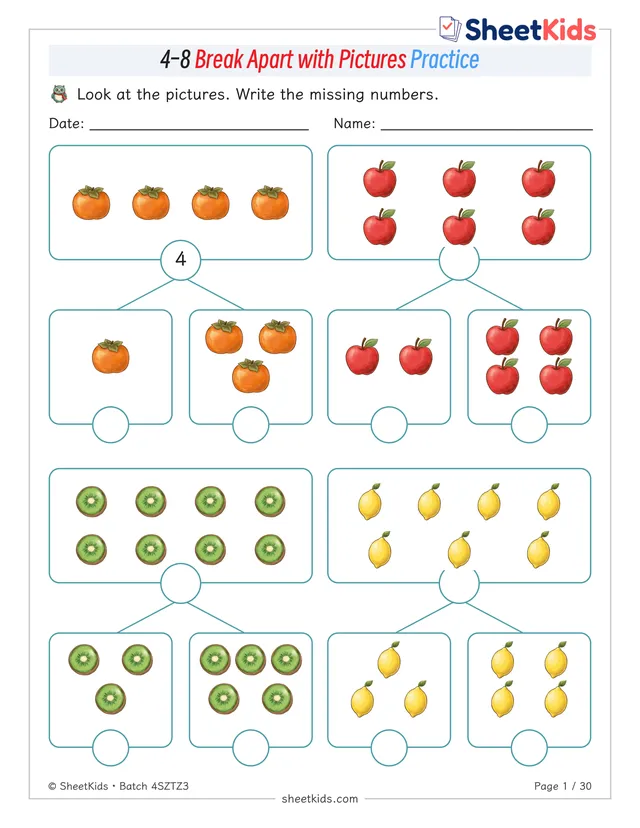
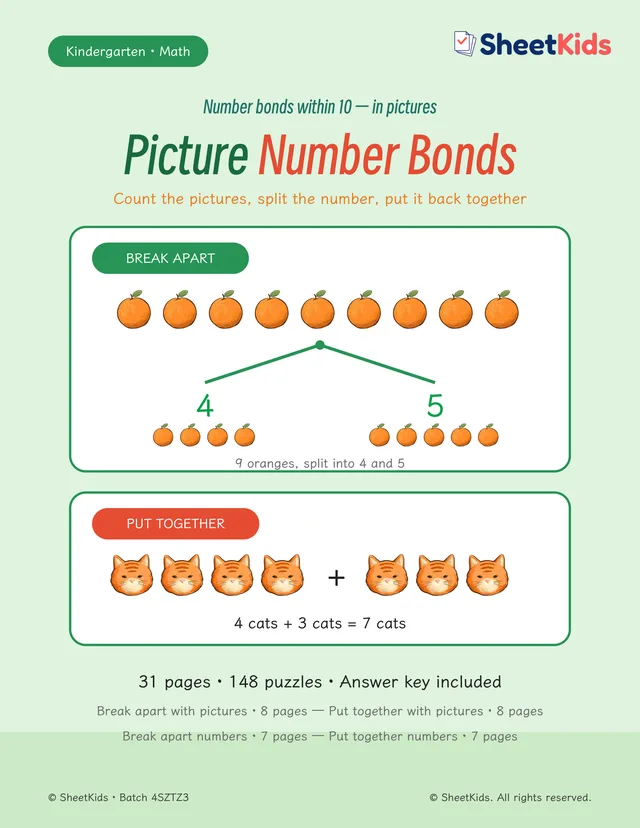
Picture Number Bonds — Break Apart & Put Together to 10
The numbers-only sections — Break Apart Numbers and Put Together Numbers — become first-grade fluency drills: the same 148 puzzles, now done from memory instead of by counting.
 Cover + page inside
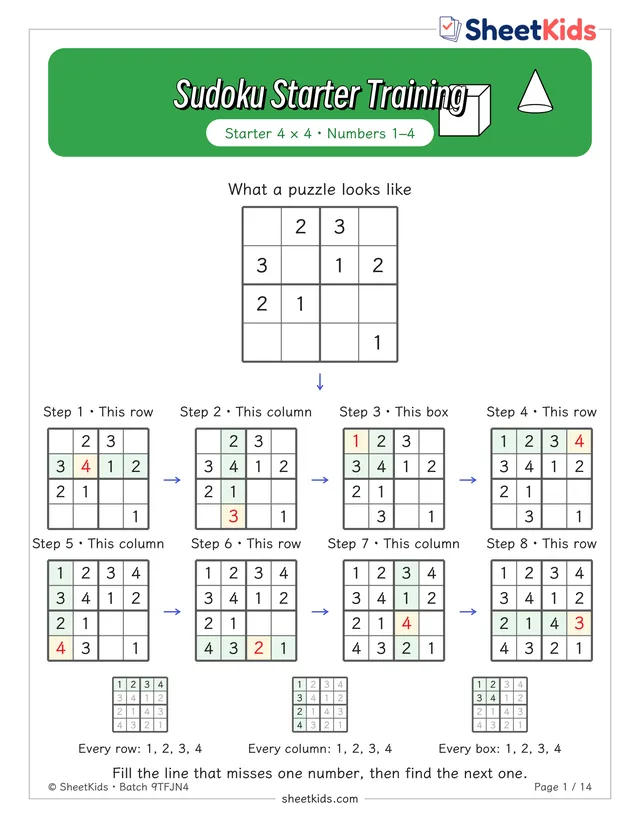
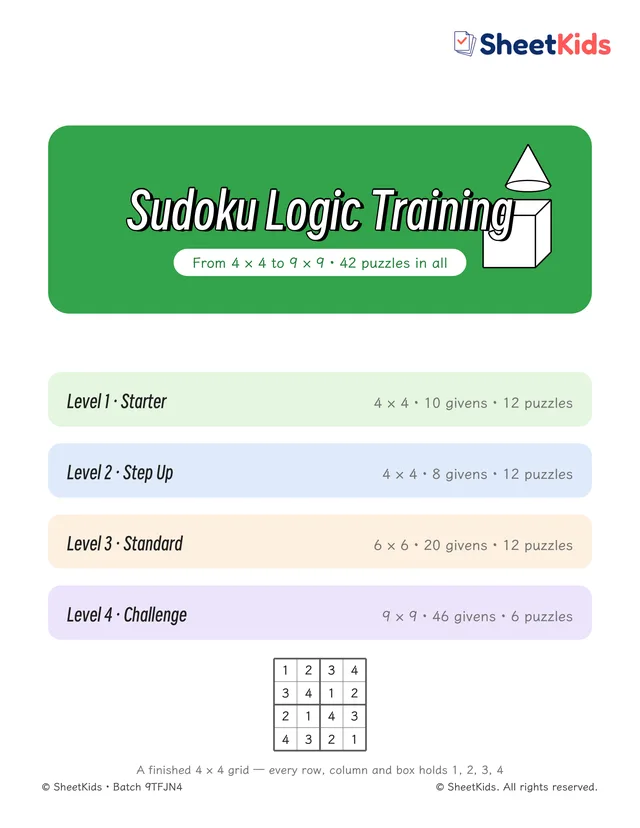
Sudoku Logic Training
First graders can take on the full ladder: bigger 6×6 grids and the 9×9 challenge, using the three solving methods the guide pages teach.
 Cover + page inside
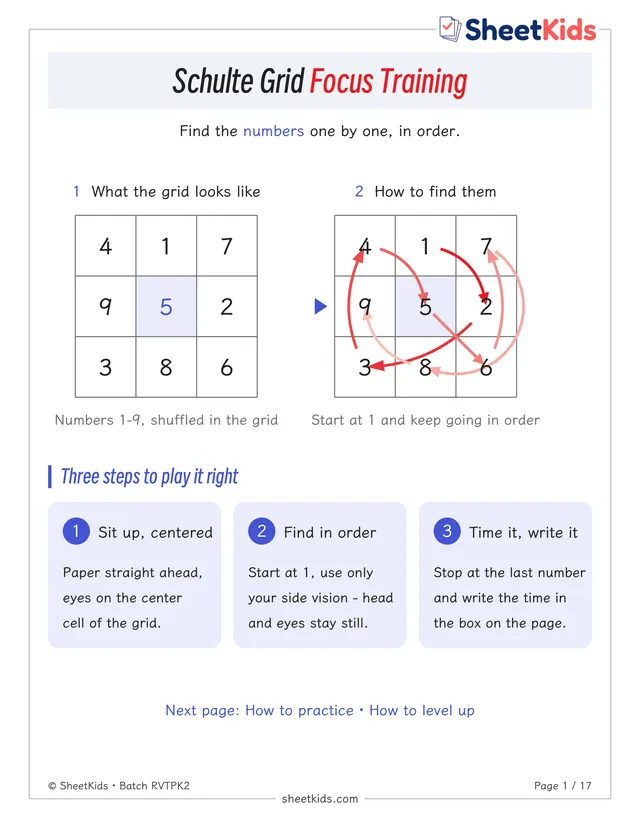
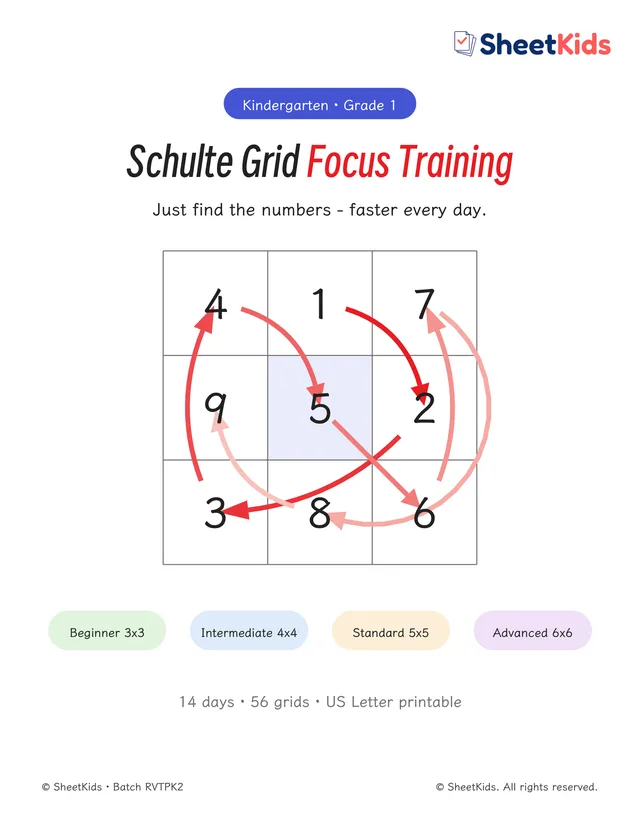
Schulte Grid Focus Training
The advanced 6×6 days are the first-grade target: fast, accurate scanning in order — quiet training for careful copying and for keeping place while reading.
A sensible order for 1st grade
Start with the strategy set and the two 'new literacy' sets (equations and time), and run the within-10 and logic sets as warm-ups and change-of-pace work alongside — first grade runs on two tracks at once.
Adding & Subtracting Within 20 with Regrouping
Do not skip the guides to reach the 'real' problems. Read one strategy guide together, do its practice page, and only move on when your child can talk you through an example. The two mixed pages at the end are the test of the whole set.
View the set → · 11 pages · 10 parts
Write the Equation
Ask for the equation before the answer: 'write what the picture says first, then solve it.' The worked examples model that order, and the answer key lets your child check both the equation and the result.
View the set → · 12 pages · 11 parts · answer key included (10 pages)
Telling Time
Pair each page with a real clock in the house. After the 'read the time' pages, the draw-the-hands pages are the important ones — setting a clock from words is harder, and more revealing, than reading one.
View the set → · 7 pages · 6 parts
Adding & Subtracting Three Numbers Within 10
Use it as a warm-up set on regrouping days. Insist on the running-total narration ('4 + 3 is 7, 7 − 2 is 5') — saying the middle answer out loud is what turns a chain into one fluent move.
View the set → · 9 pages · 8 parts · answer key included (8 pages)
Cross-Number Addition & Subtraction Puzzles Within 10
With 193 equations across 10 grids, this is the year's fluency reservoir. Teach the crossing-first habit: a cell shared by two equations gives two checks, so it is the safest place to start each grid.
View the set → · 11 pages · 10 parts · answer key included (10 pages)
Decomposing Numbers to 10
Nine pages is all it takes to keep bonds sharp. If a page reveals a shaky pair — say, what joins 6 to make 10 — that pair deserves a week of warm-ups before the next regrouping page.
View the set → · 9 pages · 2 parts
Picture Number Bonds
Skip the picture sections your child outgrew and go straight to the numeric back half. Timed gently ('how many in two minutes?'), these pages measure exactly the fluency the within-20 strategies consume.
View the set → · 31 pages · 4 parts · answer key included (30 pages)
Sudoku Logic Training
Levels 3–4 are the first-grade range. When a 9×9 stalls, send your child back to the methods pages rather than guessing — sudoku rewards system over luck, and that lesson transfers.
View the set → · 15 pages · 4 parts · answer key included (12 pages)
Schulte Grid Focus Training
Days 8–14 (5×5, then 6×6) are the first-grade stretch. One grid a day, timed against yesterday's own result, builds the steady visual tracking that board-copying at school demands.
View the set → · 18 pages · 6 parts
How It Works
Strategies before speed
Work through the four strategy guides in the Within 20 set in order, one strategy's practice page at a time. Speed drills only start once your child can explain how they got an answer.
Warm up inside 10
Open sessions with five minutes from a bonds or puzzle set. Keeping within-10 facts instant is what frees your child's attention for the new within-20 thinking.
Mix the tracks weekly
A workable week: two regrouping pages, one equations or time page, one logic page. Variety across the week keeps every thread moving without overloading any single day.
Questions Parents Ask About 1st Grade
What is the most important maths skill in 1st grade?
My child is still slow with bonds to 10. Should we wait before starting within 20?
When do children learn to tell the time?
Are the picture equations too easy for a first grader?
Which 1st grade set should we start with?
The Other Grades
Looking back is allowed: the kindergarten page holds the warm-up material first graders still profit from, and the preschool page serves younger siblings working at the same table.
Pick a set and print the first page today.
9 free sets for 1st grade, 123 pages — complete, print-ready, no sign-up.
See the 1st Grade Sets