
Free Printable Kindergarten Worksheets for Ages 5–6
Kindergarten is the year counting turns into arithmetic. Numbers up to 10 stop being a chant and become things a child can split into parts, join back together and rearrange — and that single idea, the number bond, quietly powers almost everything that comes later. This page gathers 13 complete sets, 191 pages, around that core: picture bonds first, bare-number bonds next, then first written equations and fluency games, with logic, focus and word work running alongside. Everything is free to download and print, in the order below or in any order your child prefers.
100% Screen-Free
What kindergarten practice actually builds
The number bond is the headline skill. A kindergartner who knows that 7 is 3 and 4 — and 5 and 2, and 6 and 1 — without counting on fingers owns the foundation for all of first-grade addition and subtraction. Two sets here attack it from both sides: Picture Number Bonds teaches it with groups of objects a child can see and count, and Decomposing Numbers to 10 repeats the same idea with bare numbers until it is automatic.
The next step is writing maths down. Picture Equations asks a child who can count two groups of objects to record what they see as an equation — the first time counting becomes notation. After that, fluency work can begin: three-number chains and cross-number puzzles keep bonds fast and accurate, but they only help once the bonds themselves are understood, which is why they sit further down this page.
Kindergarten is not only maths. The alphabet cards change jobs at this age — the same 260 pictured words that preschoolers named become first reading and spelling material — and the guessing flashcards turn into short texts a child can try to read before unfolding the answer. Sudoku's 4×4 starter grids and the middle Schulte grids build the logic and visual scanning that reading rows of words and numbers will soon demand.
The Kindergarten Sets
Every set recommended for kindergarten — complete, free, and ready to print, listed in a sensible starting order.
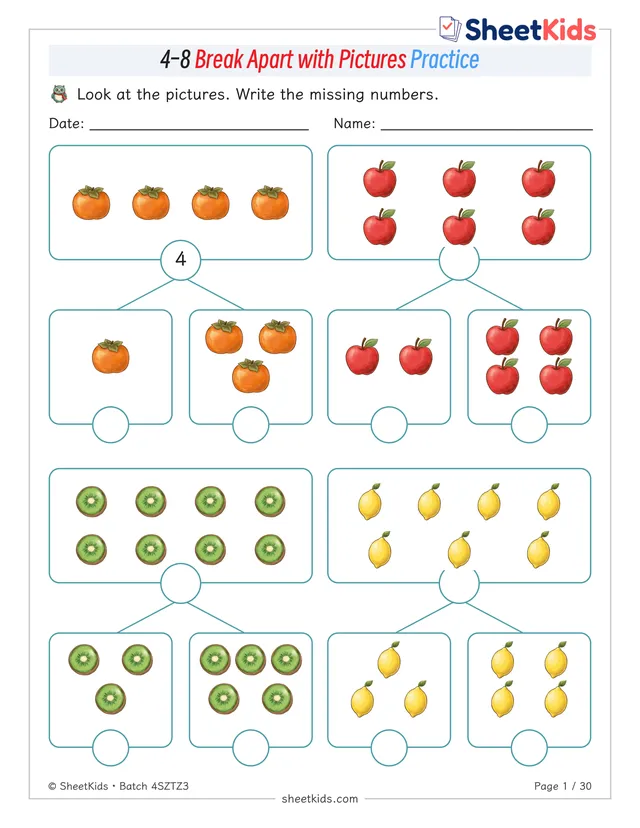
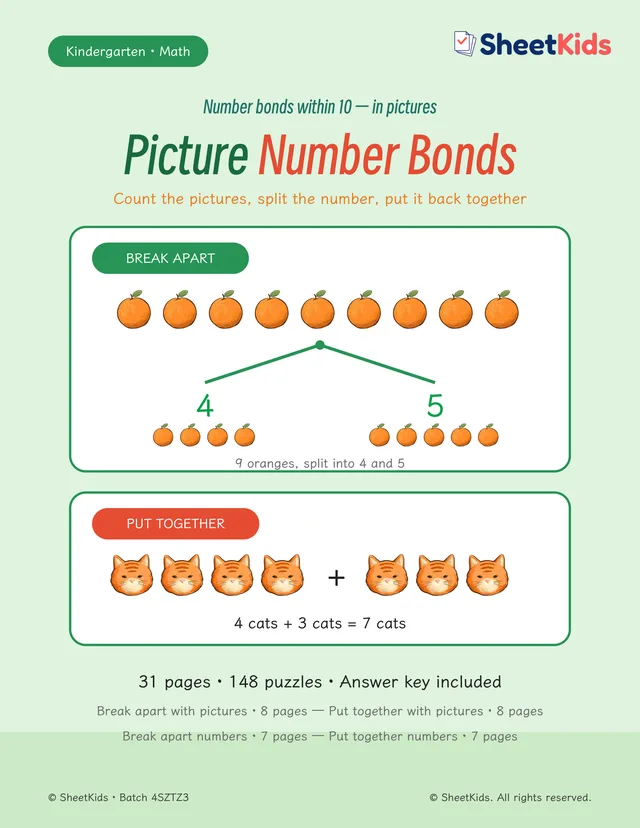 Cover + page inside
Picture Number Bonds — Break Apart & Put Together to 10
The heart of kindergarten maths: 148 picture puzzles that split a group into two parts and join parts back into a whole. Pictures carry the idea first; the numbers-only sections at the end bridge to written arithmetic.
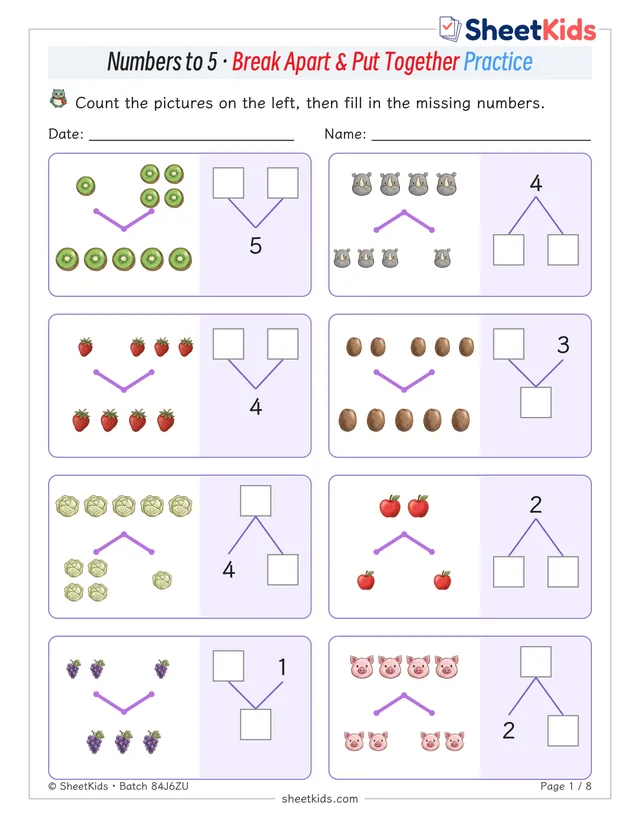
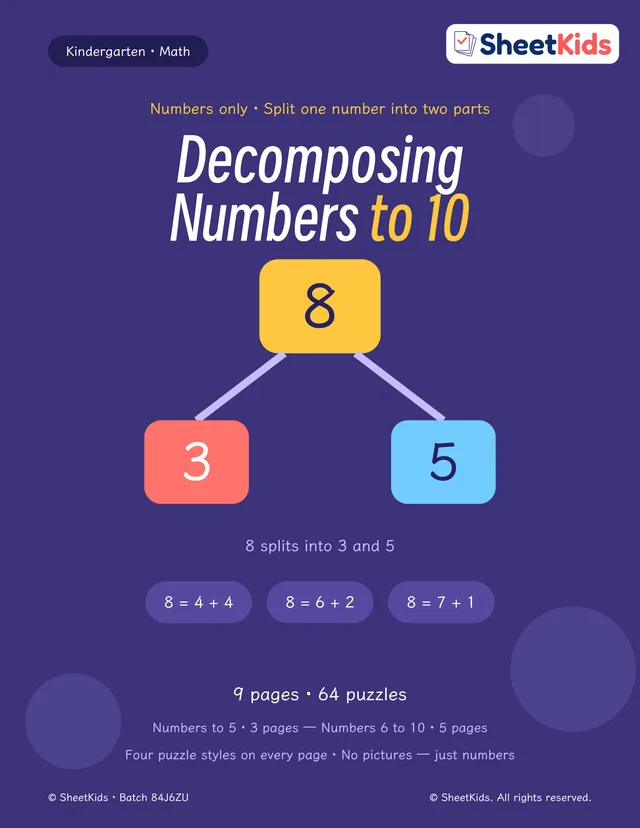 Cover + page inside
Decomposing Numbers to 10
Number bonds without the pictures: 64 puzzles that break numbers to 5, then 6 to 10, apart and put them together again. This is the set that makes '7 is 3 and 4' automatic.
 Cover + page inside
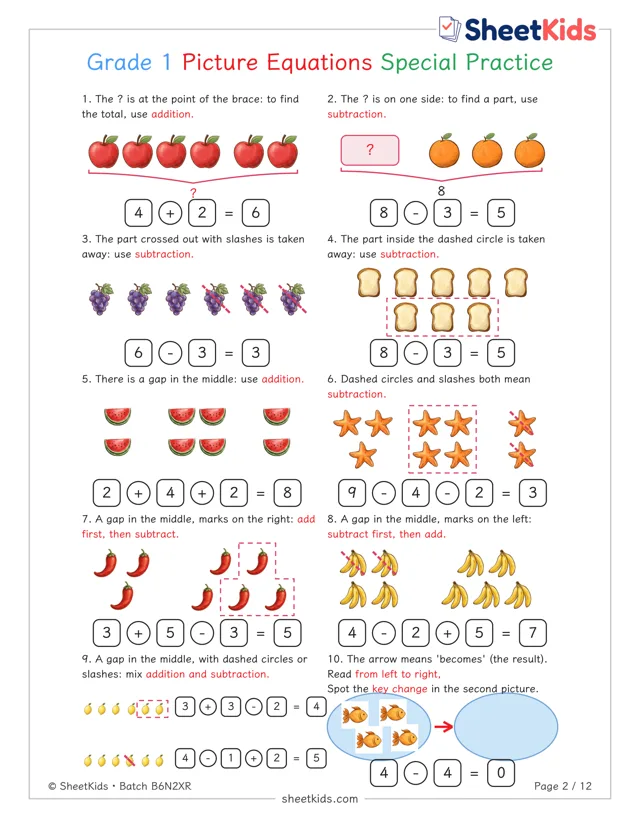
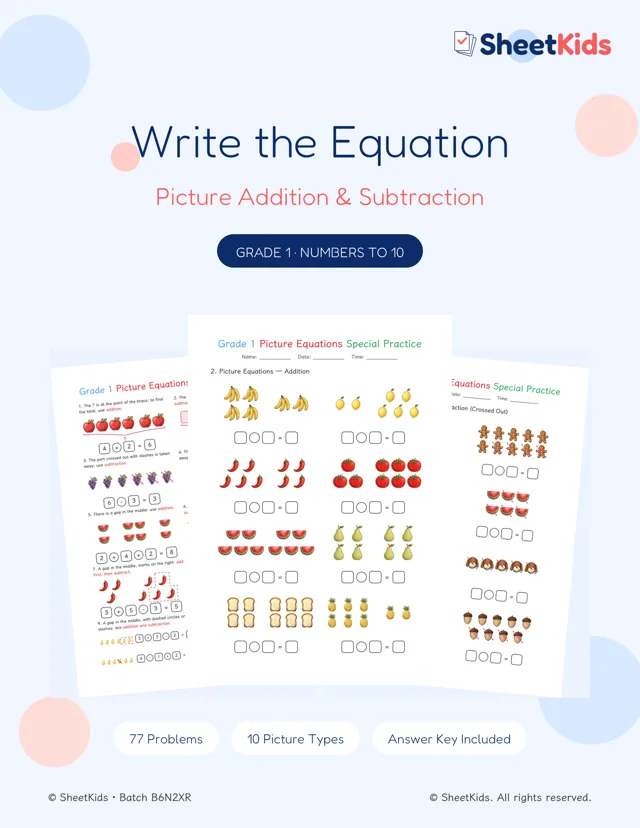
Write the Equation — Picture Addition & Subtraction
When a kindergartner can count two groups, this set asks the next question: can you write it as an equation? Seventy-seven picture problems within 10, with worked examples showing how.
 Cover + page inside
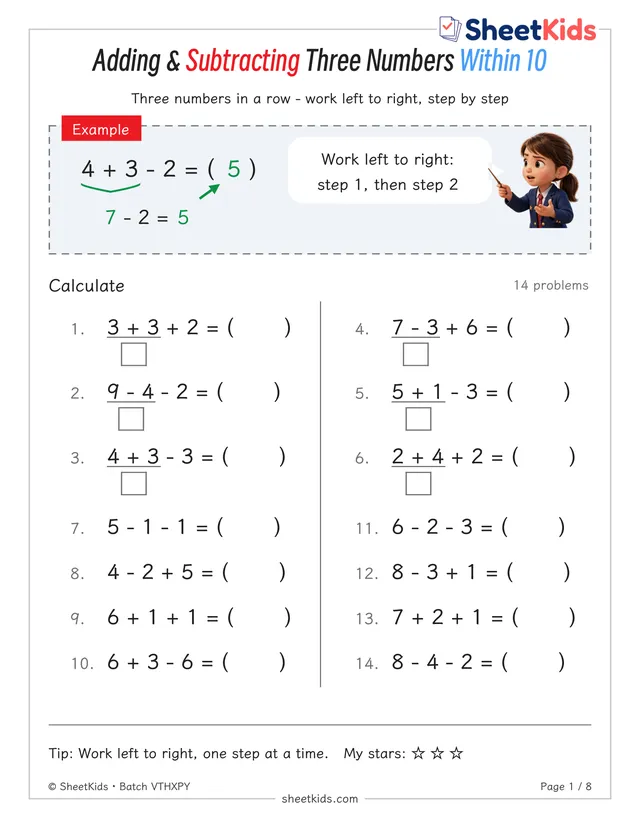
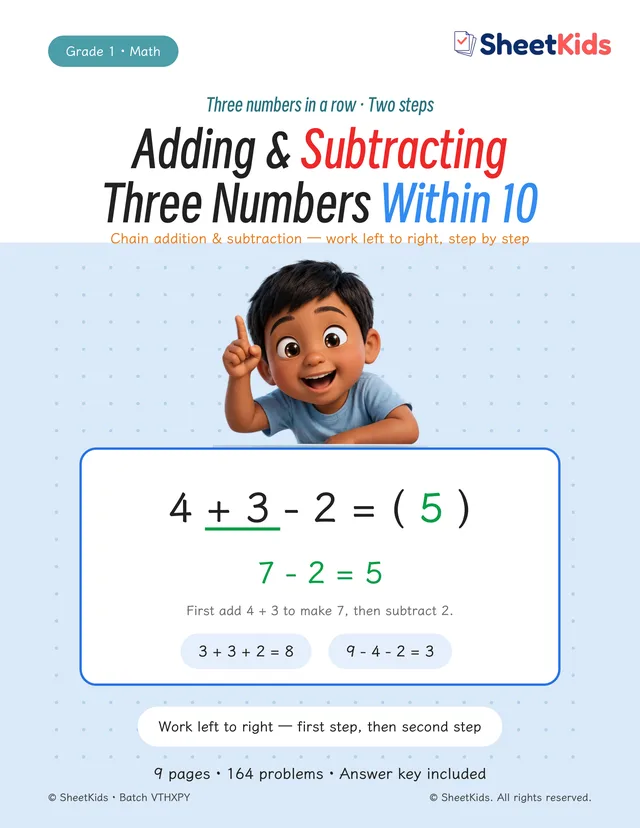
Adding & Subtracting Three Numbers Within 10
Chains like 4 + 3 − 2: three numbers, two steps, all within 10. Worked examples first, then practice — plus 'find the missing sign' puzzles that make kids read an equation before solving it.
 Cover + page inside
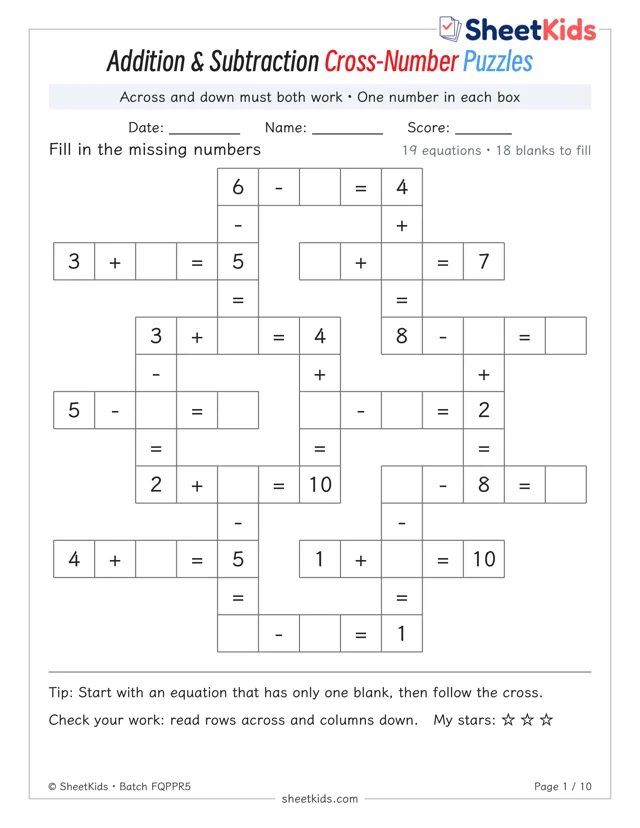
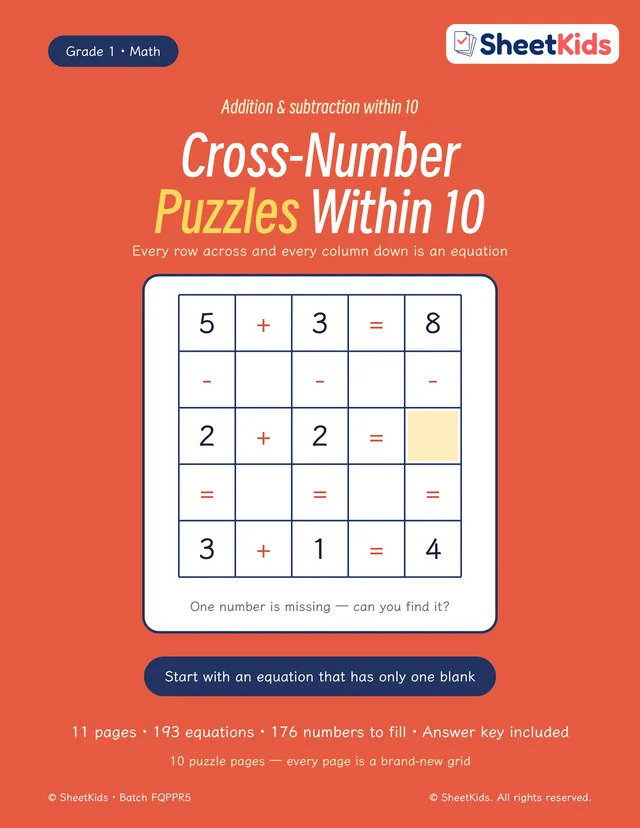
Cross-Number Addition & Subtraction Puzzles Within 10
Crossword-style grids where every row and column is an equation within 10 and the crossing cells are shared. A stretch goal for confident kindergartners — and a favourite to grow into.
 Cover + page inside
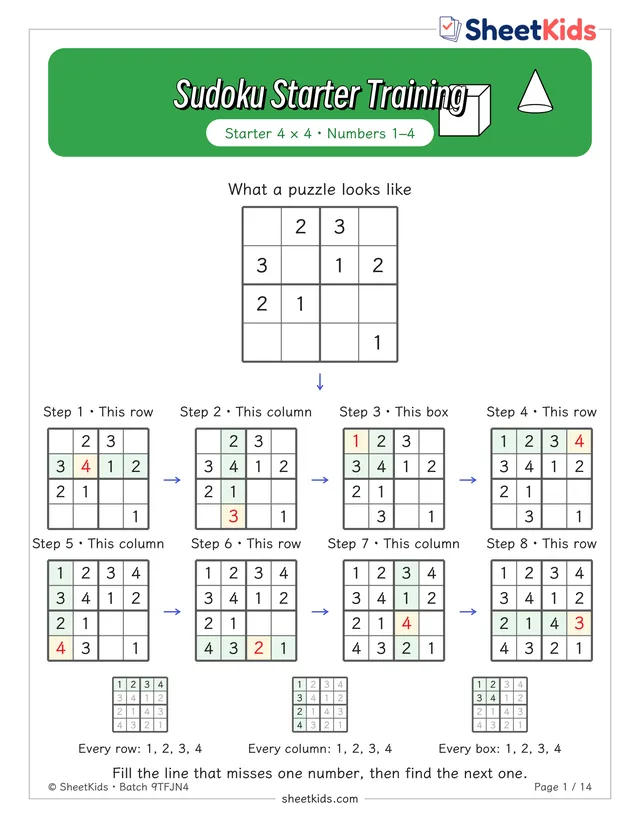
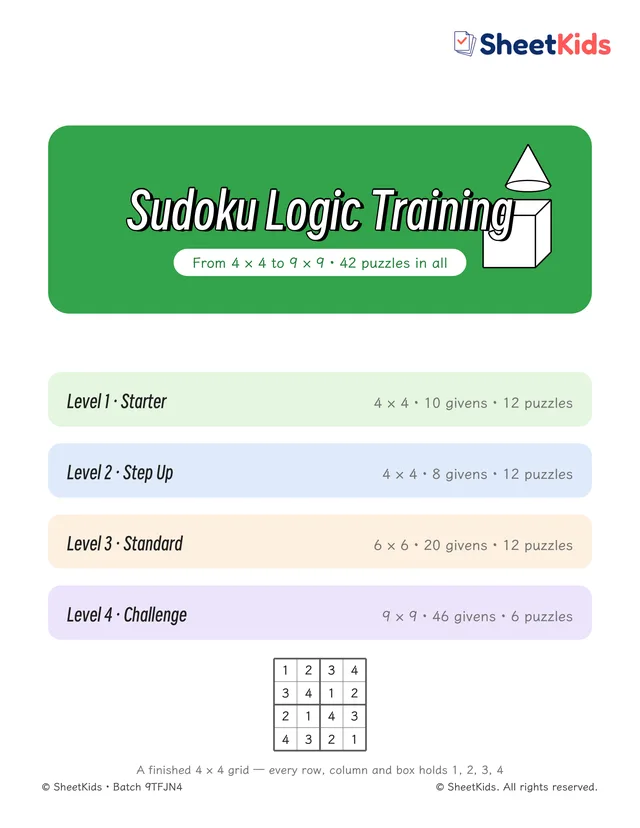
Sudoku Logic Training
Starts with friendly 4×4 grids and two pages that teach the rules like a game. Kindergartners work the early levels; the 9×9 finale can wait for first grade.
 Cover + page inside
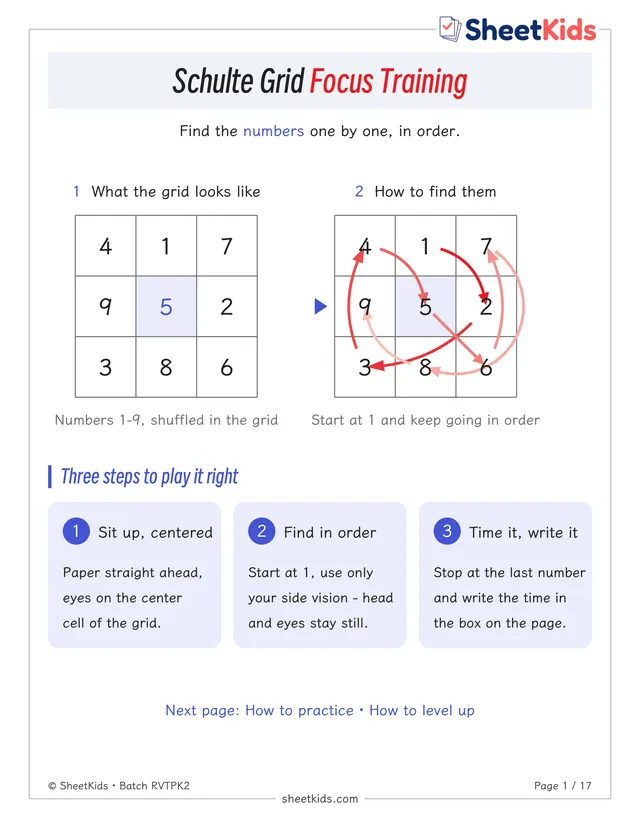
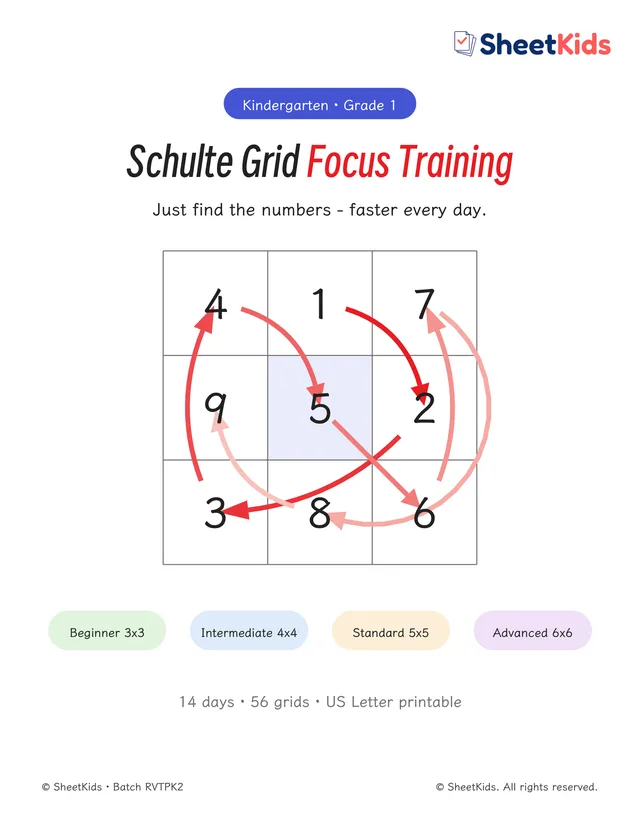
Schulte Grid Focus Training
The 4×4 and 5×5 days are the kindergarten sweet spot: scanning numbers in order builds the visual attention children need for reading rows of text and keeping place in a sum.
 Cover + page inside
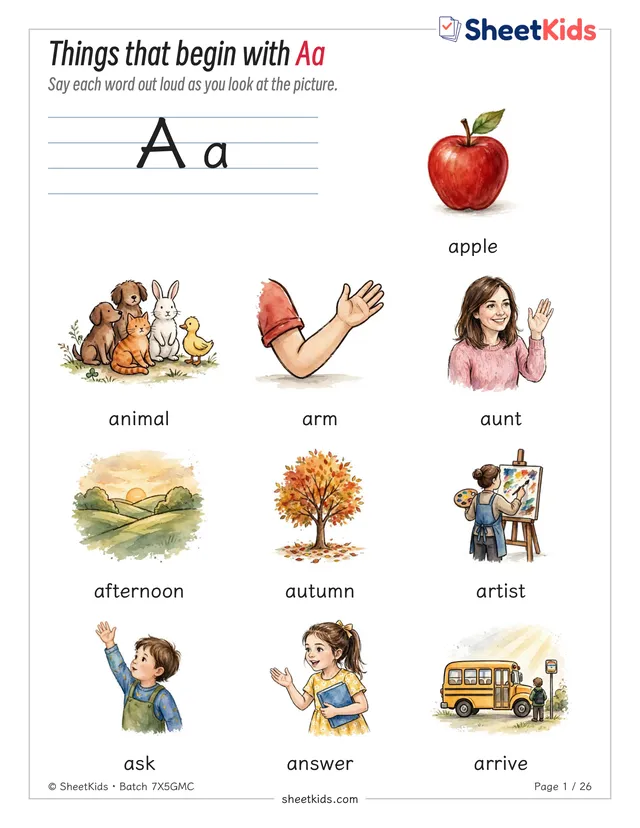
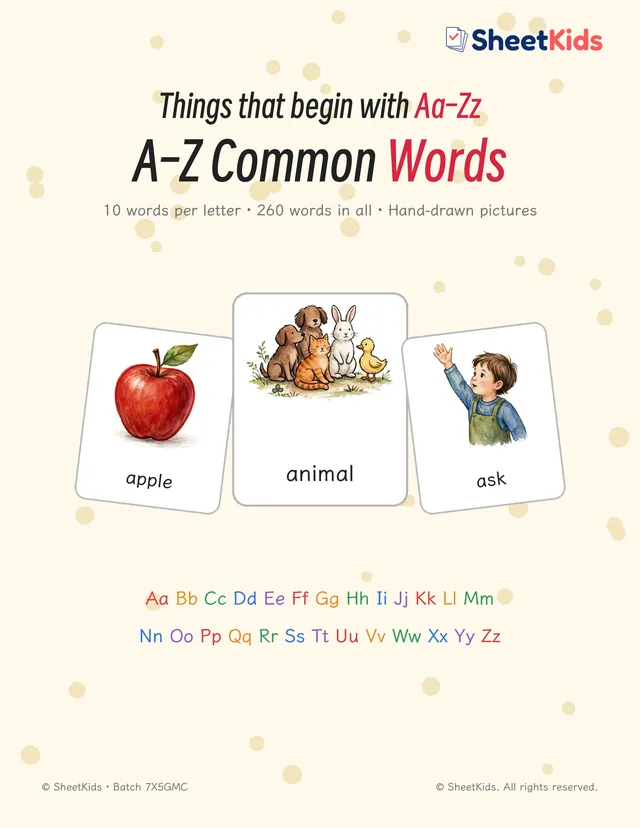
Alphabet Word Cards — Things That Begin with A-Z
In kindergarten the same 260 pictured words become reading material: sound out the first letter, match word to picture, and use favourite pages as a personal word wall.
 Cover + page inside
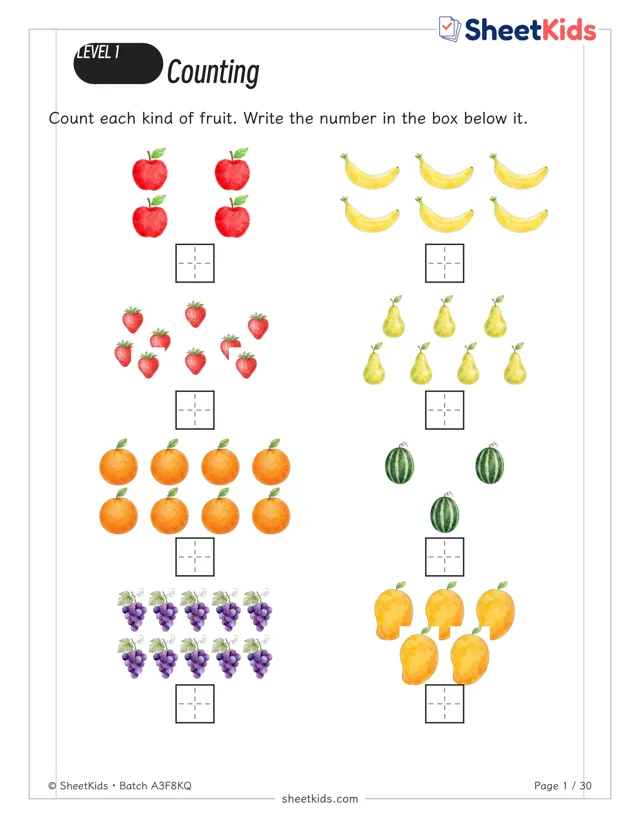
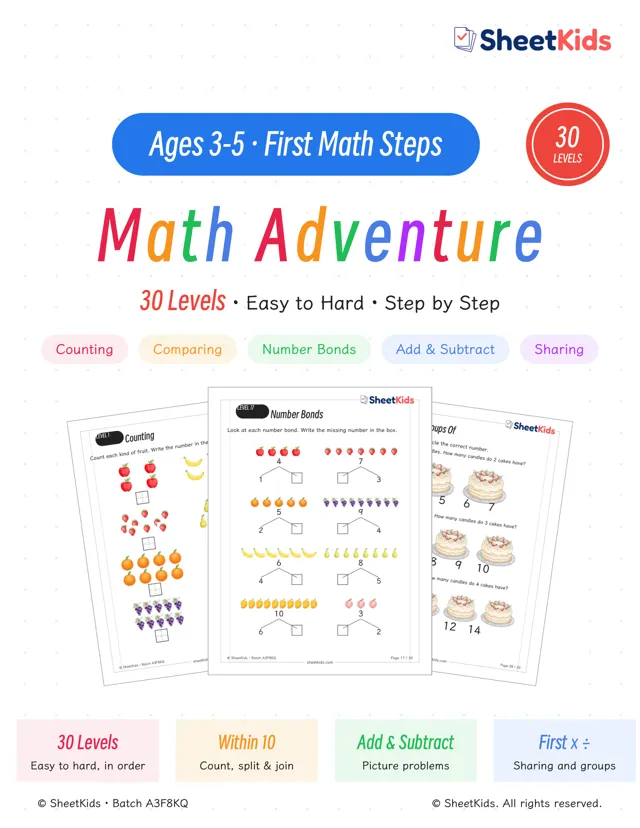
Math Adventure — 30 Levels
Started in preschool, finished here: the later levels reach number bonds and making ten, which makes completing all 30 levels a satisfying kindergarten project.
 Cover + page inside
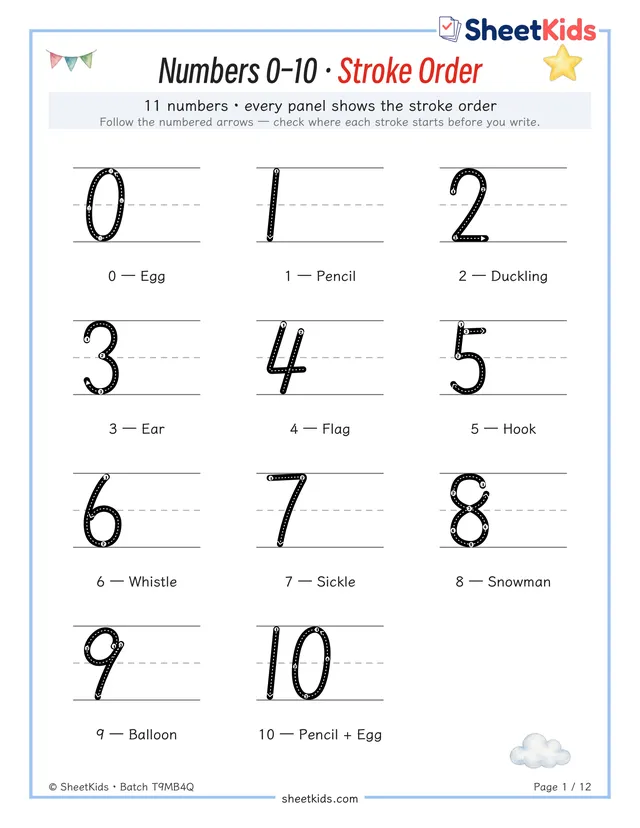
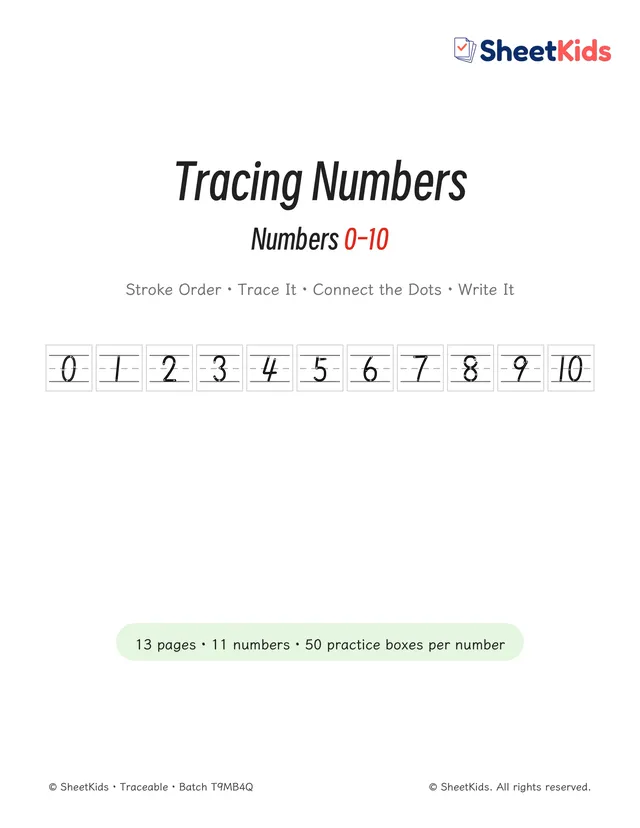
Tracing Numbers 0–10
Kindergartners still polish how numbers are formed. Stroke-order grids, a mnemonic picture for every number and write-it rows keep formation correct while writing gets faster.
 Cover + page inside
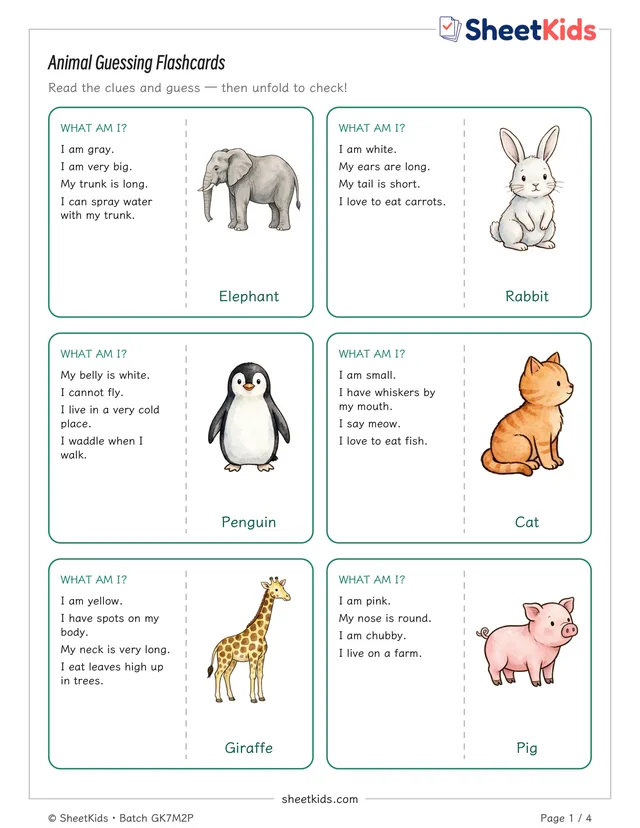
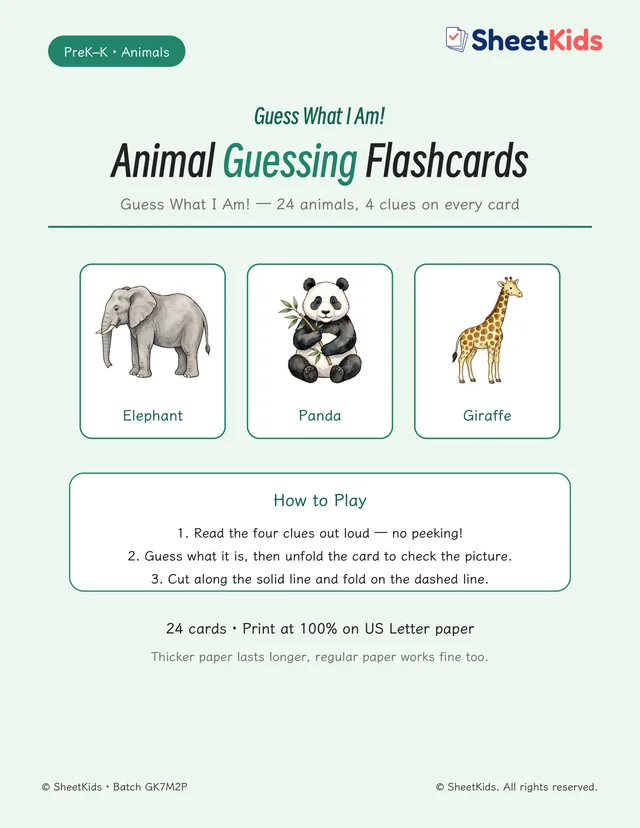
Animal Guessing Flashcards
Now the clues become reading practice: four short English clues per animal that kindergartners try to read themselves before unfolding the answer.
 Cover + page inside
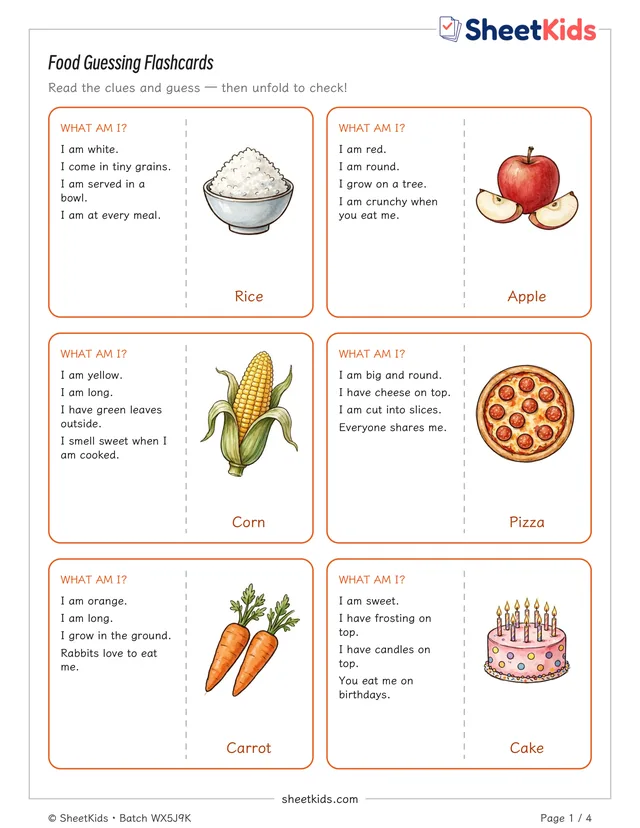
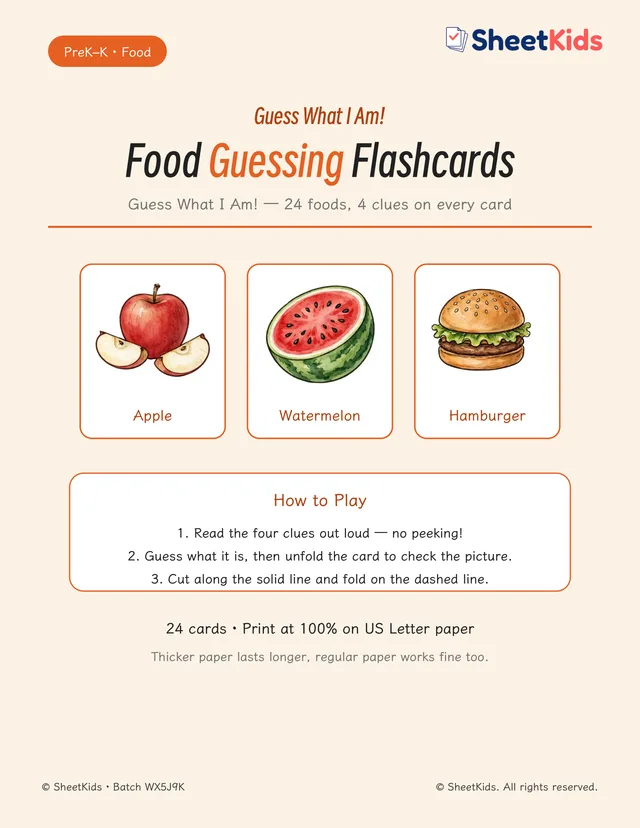
Food Guessing Flashcards
Twenty-four foods to read about and guess. Good first 'read it yourself' material, because every unfamiliar word is backed by a picture waiting on the other side of the fold.
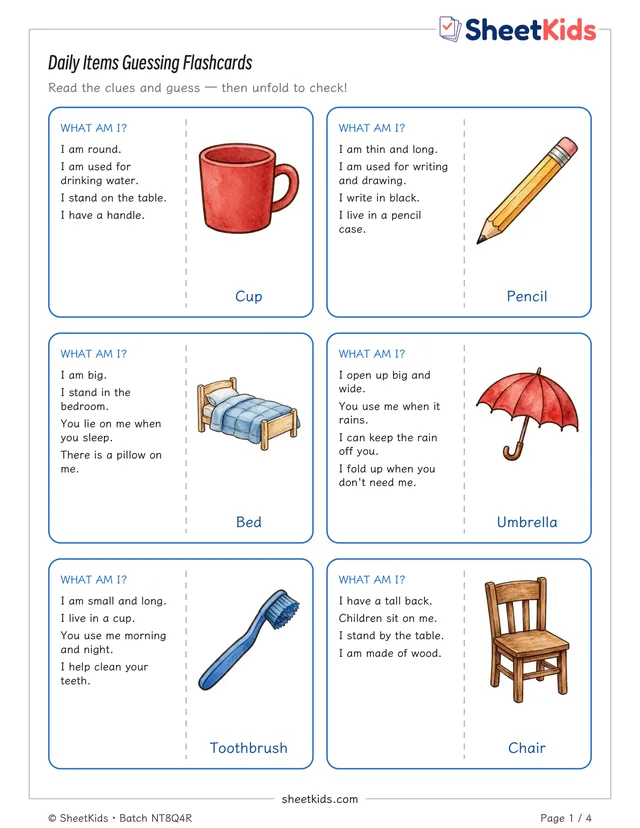
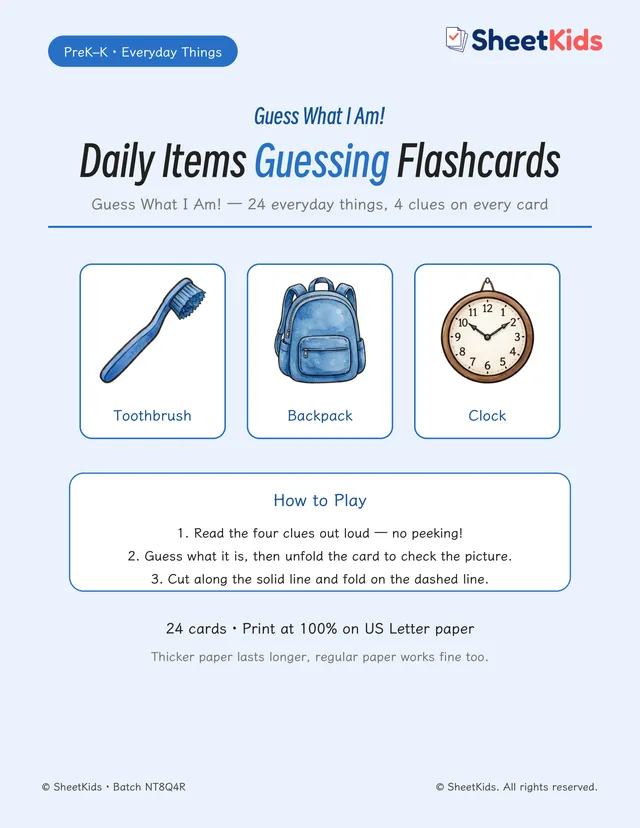 Cover + page inside
Daily Items Guessing Flashcards
Everyday words — cup, toothbrush, shoes — in clue-and-guess form. Familiar words are the easiest first reading wins, and this deck is full of them.
A sensible order for kindergarten
The list below is sequenced the way the skills depend on each other: bonds with pictures, bonds with numbers, equations, fluency, then the stretch puzzles — with words and focus practice woven through at any point.
Picture Number Bonds
Work through it in order — the picture sections come first on purpose. When your child reaches Break Apart Numbers and Put Together Numbers, they are doing the same puzzles from memory instead of counting, which is the goal.
View the set → · 31 pages · 4 parts · answer key included (30 pages)
Decomposing Numbers to 10
Pair it with Picture Number Bonds: pictures first for a new number, this set second for the same number. Short daily rounds beat long ones — the aim is instant recall, and that grows by repetition over days.
View the set → · 9 pages · 2 parts
Write the Equation
Start with the example pages and talk through how the picture turns into numbers and signs. Stay with the addition types until writing the equation feels routine, then let the subtraction types in.
View the set → · 12 pages · 11 parts · answer key included (10 pages)
Adding & Subtracting Three Numbers Within 10
This set assumes bonds to 10 are fairly solid. Teach the habit of solving left to right and saying the running total out loud ('4 + 3 is 7, 7 − 2 is 5') — that narration is the skill.
View the set → · 9 pages · 8 parts · answer key included (8 pages)
Cross-Number Addition & Subtraction Puzzles Within 10
Introduce it after the chain set. Show your child that a shared cell must satisfy two equations at once, and let them use that as a hint: fill the crossings first, and the rest of the grid unlocks.
View the set → · 11 pages · 10 parts · answer key included (10 pages)
Sudoku Logic Training
Read the two how-to pages together and solve the first 4×4 as a team. Levels 1–2 are the kindergarten range; keep the harder levels as a promise of what comes next rather than a hurdle now.
View the set → · 15 pages · 4 parts · answer key included (12 pages)
Schulte Grid Focus Training
Days 4–11 (the 4×4 and 5×5 grids) fit kindergarten best. A grid a day is plenty, and gentle timing — 'can you beat yesterday?' — works better than racing the clock.
View the set → · 18 pages · 6 parts
Alphabet Word Cards
Shift from naming to reading: cover the picture, let your child sound out the word, then check against the picture. Ten words per letter means you can follow their interests letter by letter.
View the set → · 27 pages · 26 parts
Math Adventure
If your child began this in preschool, pick up where they left off — the levels climb steadily. New to it in kindergarten? The early levels make a gentle warm-up before the bond sets.
View the set → · 31 pages · 4 parts
Tracing Numbers 0–10
Use it as handwriting maintenance alongside the maths sets: one number page before a bonds page keeps digits legible, which matters more than parents expect when equations get longer.
View the set → · 13 pages · 12 parts
Animal Guessing Flashcards
Hand over the reading job: your child reads the clues aloud, guesses, then unfolds to check the name. Twenty-four animals make a deck that lasts weeks of five-minute games.
View the set → · 5 pages · 4 parts
Food Guessing Flashcards
Sort the deck after playing: breakfast foods, fruits, things that grow. Sorting by category is early science thinking, and it gives the same words a second, different workout.
View the set → · 5 pages · 4 parts
Daily Items Guessing Flashcards
Because the objects are all at home, finish the game in the real world: read a card, then go and touch the actual toothbrush or shoe. Word-to-object matching cements new vocabulary.
View the set → · 5 pages · 4 parts
How It Works
Bonds before speed
Work through Picture Number Bonds and Decomposing Numbers to 10 before the puzzle and chain sets. Fluency games only pay off when the underlying bonds are already understood.
A little, most days
Ten focused minutes beats a weekly marathon. One page from a core set plus a flashcard game or a focus grid makes a complete kindergarten session.
Let the child check
Where a set has an answer key, check the page together and let your child find their own mistakes. Self-correcting is where the learning sticks.
Questions Parents Ask About Kindergarten
What maths should a kindergartner practise most?
My child still counts on fingers. Is that a problem?
When is a kindergartner ready for written equations?
Are sudoku and Schulte grids really kindergarten material?
Which kindergarten set should we start with?
The Other Grades
Kindergarten sits between two worlds: the preschool page is there for gentle days and younger siblings, and the 1st grade page is there for children who finish these sets early and start asking for more.
Pick a set and print the first page today.
13 free sets for kindergarten, 191 pages — complete, print-ready, no sign-up.
See the Kindergarten Sets