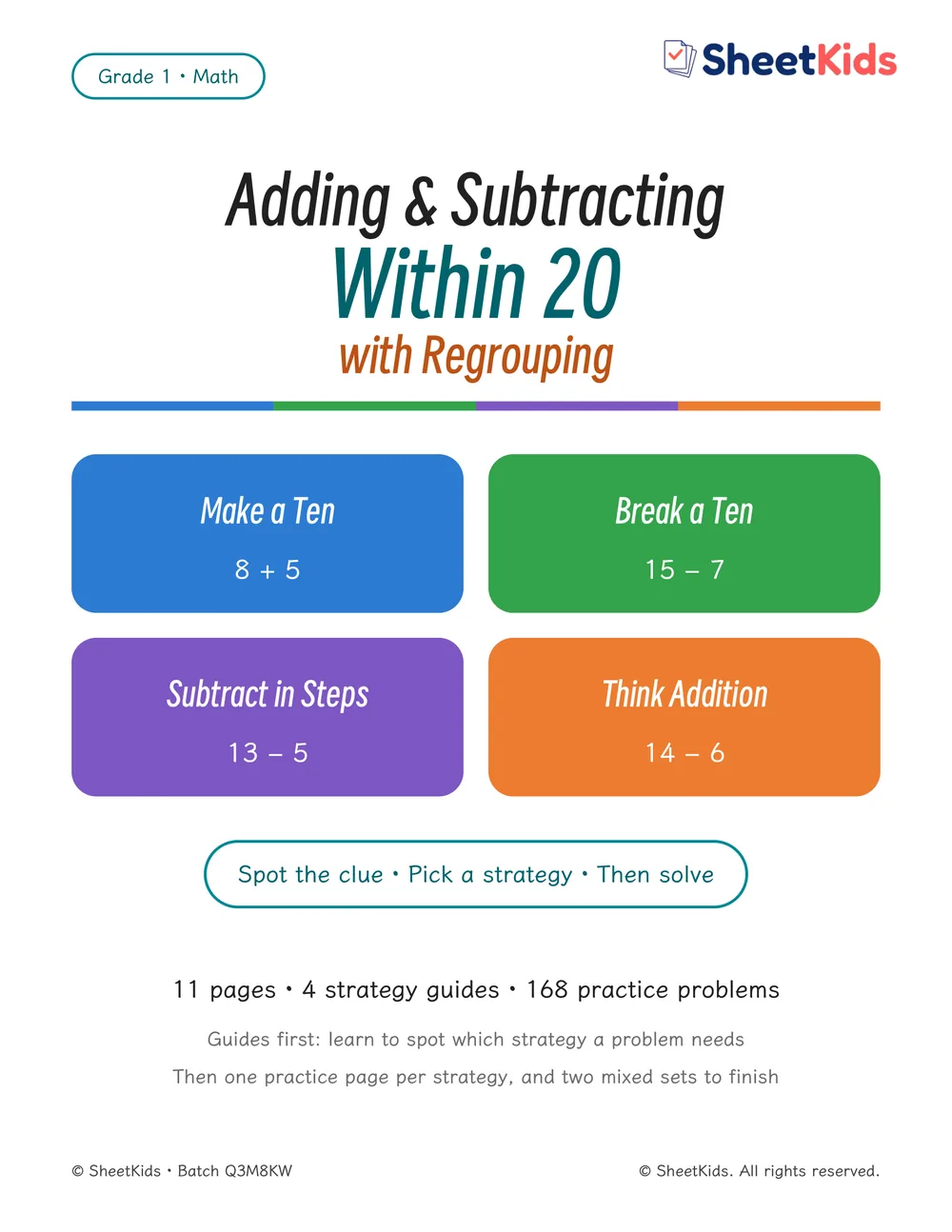
Adding & Subtracting Within 20 with Regrouping
205 items: 37 strategy-guide entries (4 guides) + 168 problems (4 strategy practice pages x24 + 2 mixed pages x36)
100% Screen-Free
Free, really. No sign-up, no email, no paywall — the complete 11-page set. Start with the free sample if you like.
What's Inside: 10 parts, 205 items — in order
Every part keeps the same page layout, so the routine is learned once and all the attention goes to the work itself. Below the overview, the first pages are shown exactly as they print — and the full index lists every item in the set.
The first four pages
All 205 items — the full index, part by part
Make a Ten — Strategy Guide – Break a Ten — Practice85 items
Make a Ten — Strategy GuideThe clue: The two numbers add up past 10 (8 + 5 = 13, more than 10), so use Make a Ten. · Which number first: Look at the bigger number 8: 8 and 2 make 10, so split a 2 out of the smaller number 5. · The call: Clue matched: the sum passes 10 and carries → Make a Ten (look at the bigger number, split the smaller one). · 1 and 9: 1 and 9 are good friends · 2 and 8: 2 and 8 hold hands · 3 and 7: 3 and 7 are close pals · 4 and 6: 4 and 6 walk together · 5 and 5: 5 and 5 make a pair of hands · Step 1: Look at the bigger number 8 and think 2 (8 and 2 make 10). · Step 2: Split the smaller number 5 into 2 and 3. · Step 3: First 8 + 2 = 10, then 10 + 3 = 13. · Splitting the wrong number: Split the smaller number, not the bigger one; the first part must make 10 with the bigger number. · Stopping at 10: After you make 10, add the part that is left.
Break a Ten — Strategy GuideThe clue: The ones digit 5 < 7 — not enough to subtract, so use Break a Ten. · Which number first: Look at the first number 15: break it open into 10 and 5. · The call: Clue matched: the ones digit is smaller than the number you subtract → Break a Ten (split the first number). · Step 1: Split 15 into 10 and 5. · Step 2: First 10 − 7 = 3. · Step 3: Then 3 + 5 = 8. · Forgetting the ones: After you subtract from 10, always add back the ones digit 5 of the first number. · Flipping the numbers: When the ones are not enough, doing 7 − 5 is wrong.
Subtract in Steps — Strategy GuideThe clue: The ones digit 3 < 5 — not enough to subtract, so use Subtract in Steps. · Which number first: Look at the number you subtract, 5: split it into 3 and 2, and subtract the ones digit 3 first to land on 10. · The call: Clue matched: the ones digit is smaller than the number you subtract → Subtract in Steps (split the number you subtract). · Step 1: Split 5 into 3 and 2. · Step 2: First 13 − 3 = 10 (land on 10). · Step 3: Then 10 − 2 = 8. · Wrong first step: The first amount subtracted must equal the ones digit, so you land on 10 first. · Subtracting only once: Landing on 10 is not the answer; subtract the rest too.
Think Addition — Strategy GuideThe clue: The ones digit 4 < 6 — not enough to subtract, so you can use Think Addition. · What to think first: Think addition: 6 plus what equals 14? 6 + 8 = 14. · The call: Clue matched: the ones digit is smaller than the number you subtract → Think Addition (flip it into adding). · Step 1: Think: 6 + ( ) = 14. · Step 2: 6 + 8 = 14, so 14 − 6 = 8. · Step 3: Check: 8 + 6 = 14. It matches. · Wrong addition fact: In your addition thought, the sum must equal the first number exactly. · Skipping the check: Check with answer + the number you subtracted; it must equal the first number.
Make a Ten — Practice9 + 4 = ( ) · 8 + 6 = ( ) · 7 + 5 = ( ) · 9 + 6 = ( ) · 6 + 5 = ( ) · 8 + 3 = ( ) · 9 + 3 = ( ) · 8 + 7 = ( ) · 7 + 4 = ( ) · 5 + 6 = ( ) · 9 + 8 = ( ) · 6 + 6 = ( ) · 7 + 7 = ( ) · 8 + 4 = ( ) · 9 + 5 = ( ) · 5 + 7 = ( ) · 6 + 8 = ( ) · 9 + 7 = ( ) · 9 + 2 = ( ) · 10 + 4 = ( ) · 7 + 6 = ( ) · 5 + 2 = ( ) · 6 + 7 = ( ) · 4 + 3 = ( )
Break a Ten — Practice14 - 8 = ( ) · 12 - 4 = ( ) · 16 - 9 = ( ) · 17 - 9 = ( ) · 11 - 3 = ( ) · 15 - 6 = ( ) · 12 - 7 = ( ) · 14 - 5 = ( ) · 11 - 6 = ( ) · 16 - 8 = ( ) · 13 - 7 = ( ) · 15 - 9 = ( ) · 12 - 3 = ( ) · 14 - 9 = ( ) · 11 - 4 = ( ) · 17 - 8 = ( ) · 13 - 4 = ( ) · 16 - 7 = ( ) · 12 - 8 = ( ) · 17 - 5 = ( ) · 11 - 2 = ( ) · 15 - 3 = ( ) · 13 - 8 = ( ) · 19 - 6 = ( )
Subtract in Steps — Practice – Mixed Practice — Set 2120 items
Subtract in Steps — Practice14 - 7 = ( ) · 12 - 5 = ( ) · 16 - 8 = ( ) · 13 - 6 = ( ) · 15 - 8 = ( ) · 11 - 4 = ( ) · 12 - 3 = ( ) · 17 - 9 = ( ) · 14 - 5 = ( ) · 13 - 4 = ( ) · 16 - 7 = ( ) · 12 - 6 = ( ) · 15 - 6 = ( ) · 11 - 5 = ( ) · 14 - 8 = ( ) · 13 - 7 = ( ) · 17 - 8 = ( ) · 12 - 7 = ( ) · 12 - 9 = ( ) · 16 - 3 = ( ) · 15 - 7 = ( ) · 18 - 4 = ( ) · 11 - 3 = ( ) · 17 - 6 = ( )
Think Addition — Practice12 - 7 = ( ) · 11 - 5 = ( ) · 14 - 9 = ( ) · 13 - 4 = ( ) · 15 - 9 = ( ) · 12 - 8 = ( ) · 11 - 7 = ( ) · 13 - 8 = ( ) · 16 - 9 = ( ) · 12 - 5 = ( ) · 14 - 7 = ( ) · 15 - 7 = ( ) · 11 - 3 = ( ) · 13 - 6 = ( ) · 17 - 9 = ( ) · 12 - 6 = ( ) · 14 - 5 = ( ) · 16 - 8 = ( ) · 12 - 4 = ( ) · 15 - 2 = ( ) · 14 - 8 = ( ) · 16 - 5 = ( ) · 11 - 6 = ( ) · 18 - 7 = ( )
Mixed Practice — Set 19 + 5 = ( ) · 12 - 3 = ( ) · 9 + 3 = ( ) · 14 - 7 = ( ) · 14 - 8 = ( ) · 7 + 8 = ( ) · 17 - 8 = ( ) · 12 - 8 = ( ) · 8 + 9 = ( ) · 15 - 6 = ( ) · 14 - 6 = ( ) · 11 - 9 = ( ) · 14 - 5 = ( ) · 9 + 8 = ( ) · 17 - 9 = ( ) · 11 - 3 = ( ) · 8 + 5 = ( ) · 9 + 2 = ( ) · 5 + 8 = ( ) · 8 + 6 = ( ) · 6 + 9 = ( ) · 2 + 9 = ( ) · 6 + 5 = ( ) · 11 - 2 = ( ) · 5 + 7 = ( ) · 4 + 9 = ( ) · 12 - 6 = ( ) · 9 + 4 = ( ) · 7 + 4 = ( ) · 12 - 5 = ( ) · 11 - 8 = ( ) · 13 - 7 = ( ) · 8 + 4 = ( ) · 16 - 8 = ( ) · 15 - 7 = ( ) · 6 + 7 = ( )
Mixed Practice — Set 216 - 7 = ( ) · 9 + 7 = ( ) · 8 + 3 = ( ) · 9 + 9 = ( ) · 7 + 9 = ( ) · 13 - 8 = ( ) · 4 + 8 = ( ) · 11 - 7 = ( ) · 7 + 6 = ( ) · 11 - 6 = ( ) · 12 - 7 = ( ) · 16 - 9 = ( ) · 13 - 6 = ( ) · 15 - 8 = ( ) · 13 - 9 = ( ) · 13 - 4 = ( ) · 5 + 6 = ( ) · 11 - 5 = ( ) · 7 + 7 = ( ) · 6 + 8 = ( ) · 4 + 7 = ( ) · 9 + 6 = ( ) · 13 - 5 = ( ) · 18 - 9 = ( ) · 8 + 7 = ( ) · 6 + 6 = ( ) · 3 + 8 = ( ) · 11 - 4 = ( ) · 7 + 5 = ( ) · 5 + 9 = ( ) · 12 - 4 = ( ) · 3 + 9 = ( ) · 14 - 9 = ( ) · 12 - 9 = ( ) · 15 - 9 = ( ) · 8 + 8 = ( )
Adding & Subtracting Within 20 with Regrouping: Skills & How to Use
How to work through this set, step by step — and exactly what it practices, part by part.
A parent’s guide to the 10 parts
- Download & printPrint the 11-page set on US Letter (8.5″ × 11″) at 100% scale. Keep the pages in order — the set is sequenced.
- Work front to backThe 10 parts build in order: Make a Ten — Strategy Guide → Break a Ten — Strategy Guide → Subtract in Steps — Strategy Guide → Think Addition — Strategy Guide → Make a Ten — Practice → Break a Ten — Practice → Subtract in Steps — Practice → Think Addition — Practice → Mixed Practice — Set 1 → Mixed Practice — Set 2. One page at a sitting is plenty.
- Self-checking pagesNo answer key is needed for this set — the correct forms and answers are shown on the pages themselves, so kids can compare as they go.
- Reprint favoritesThe PDF is yours to print again — revisit tricky pages after a week and watch them feel easy.
US Letter (8.5″ × 11″), 100% scale ("actual size"), single-sided. Black-and-white friendly — a home inkjet on standard paper is all you need.
Skills covered
13 items · Page 1.
8 items · Page 2.
8 items · Page 3.
8 items · Page 4.
24 items · Page 5.
24 items · Page 6.
120 more items — every one is listed in the full index above.
Keep Going: Related Sets
More Math sets that pair naturally with this one.
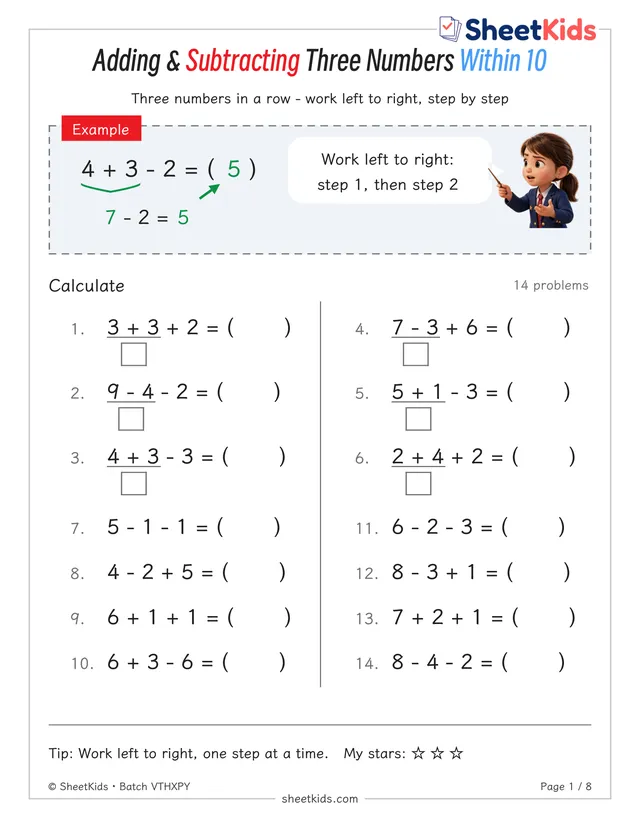
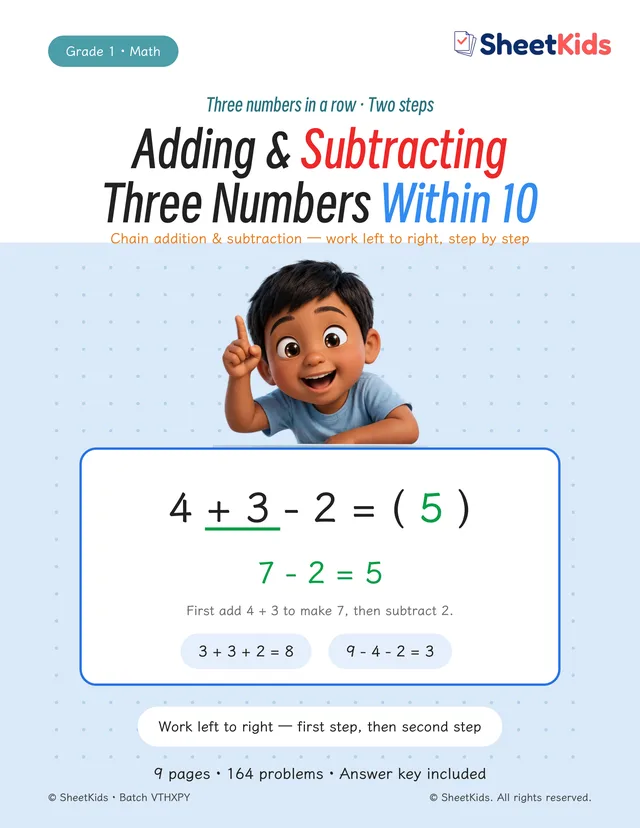 Cover + page inside
Adding & Subtracting Three Numbers Within 10
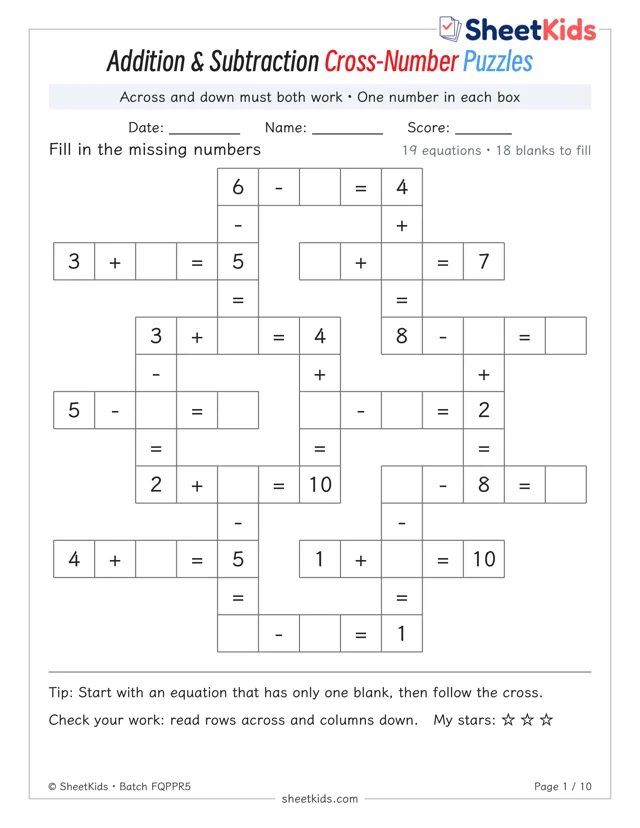
 Cover + page inside
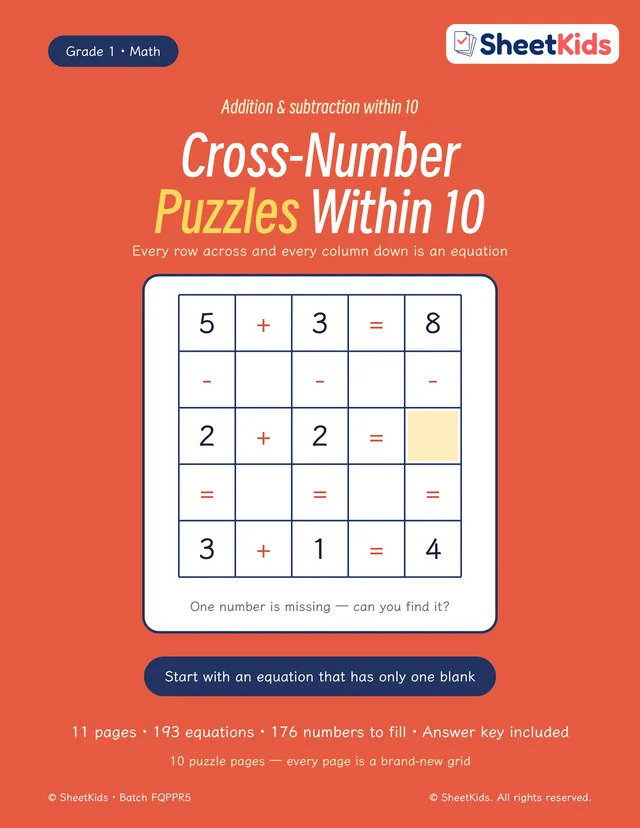
Cross-Number Addition & Subtraction Puzzles Within 10
 Cover + page inside
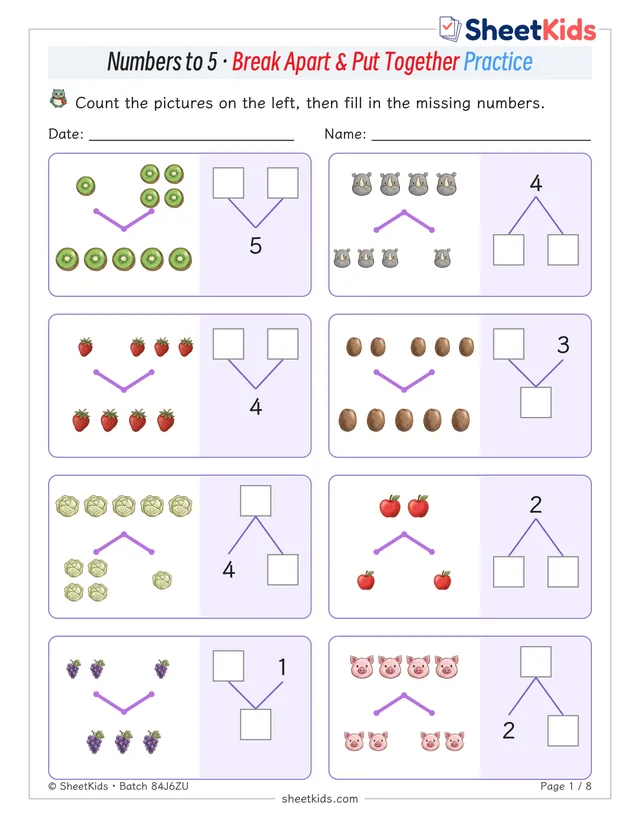
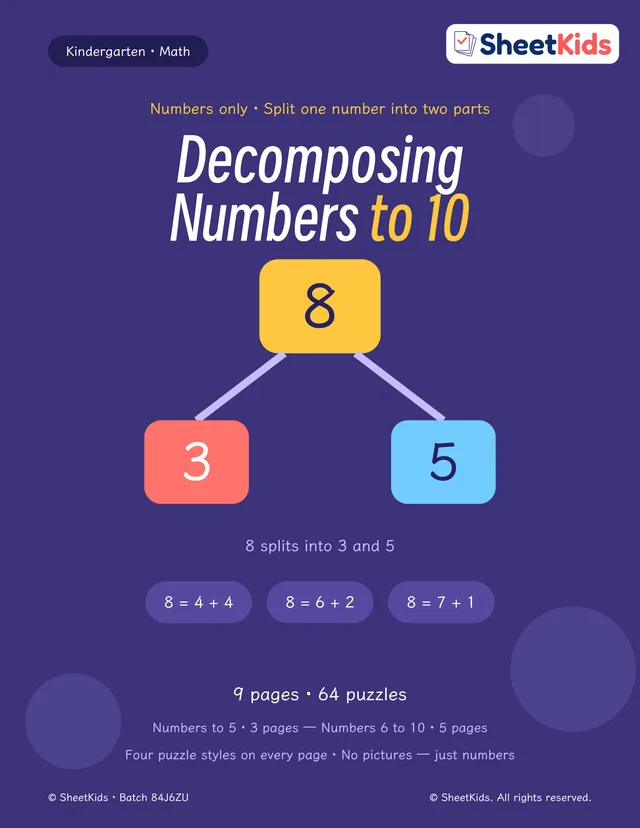
Decomposing Numbers to 10
Questions Parents Ask
How many pages are in this set?
Does this set include an answer key?
What paper and print settings should I use?
Is this set really free? Do I need to sign up?
What's in the download?
Ready? Download Adding & Subtracting Within 20 with Regrouping — free.
11 pages · 205 items · print-ready PDF on US Letter (8.5″ × 11″). No sign-up.
Save your sanity, one sheet at a time.